Pearson+ LogoPearson+ Logo
Ch. 13 - Regulation of Gene Expression in Eukaryotes
Sanders - Genetic Analysis: An Integrated Approach 3rd Edition
Sanders3rd EditionGenetic Analysis: An Integrated ApproachISBN: 9780135564172Not the one you use?Change textbook
Chapter 13, Problem 16

How does dsRNA lead to posttranscriptonal gene silencing?

Verified step by step guidance
1
Double-stranded RNA (dsRNA) is recognized by the cell as a signal to initiate the RNA interference (RNAi) pathway.
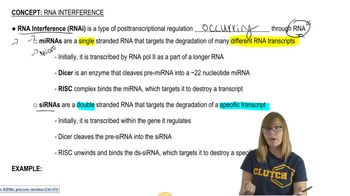
The enzyme Dicer processes the dsRNA into small interfering RNAs (siRNAs), which are typically 21-23 nucleotides in length.
These siRNAs are incorporated into the RNA-induced silencing complex (RISC), where they are unwound into single strands.
The RISC, guided by the siRNA, binds to complementary mRNA molecules in the cytoplasm.
Once bound, the RISC cleaves the target mRNA, leading to its degradation and preventing translation, thus silencing the gene post-transcriptionally.

Verified video answer for a similar problem:

This video solution was recommended by our tutors as helpful for the problem above.
Video duration:
2m
Was this helpful?

Key Concepts

Here are the essential concepts you must grasp in order to answer the question correctly.

Double-stranded RNA (dsRNA)

Double-stranded RNA (dsRNA) is a type of RNA that consists of two complementary strands. It plays a crucial role in the regulation of gene expression and is often associated with viral infections. In the context of gene silencing, dsRNA can trigger cellular mechanisms that target and degrade specific mRNA molecules, thereby preventing their translation into proteins.
Recommended video:

RNA interference (RNAi)

RNA interference (RNAi) is a biological process in which RNA molecules inhibit gene expression by causing the degradation of specific mRNA. This process is initiated when dsRNA is recognized by the enzyme Dicer, which cleaves it into small interfering RNAs (siRNAs). These siRNAs then guide the RNA-induced silencing complex (RISC) to complementary mRNA targets, leading to their silencing.
Recommended video:
Guided course
06:59
RNA Interference

Post-transcriptional gene silencing

Post-transcriptional gene silencing refers to the regulation of gene expression at the mRNA level, preventing translation into proteins. This process can occur through mechanisms such as mRNA degradation or translational repression, often mediated by small RNA molecules like siRNAs. dsRNA is a key trigger for this silencing, as it activates the RNAi pathway, leading to the targeted destruction of specific mRNAs.
Recommended video:
Guided course
04:30
Post Translational Modifications
Related Practice
Textbook Question

Define epigenetics, and provide examples illustrating your definition.

972
views
Textbook Question

What is one proposed role for lncRNAs?

1074
views
Textbook Question

What are the sources of dsRNA? Diagram the mechanisms by which dsRNAs are produced and processed into small RNAs.

1065
views
Textbook Question

A hereditary disease is inherited as an autosomal recessive trait1. The wild-type allele of the disease gene produces a mature mRNA that is 1250 nucleotides (nt) long. Molecular analysis shows that the mature mRNA consists of four exons that measure 400 nt (exon 1), 320 nt (exon 2), 230 nt (exon 3), and 300 nt (exon 4). A mother and father with two healthy children and two children with the disease have northern blot analysis performed in a medical genetics laboratory. The results of the northern blot for each family member are shown here. Identify the genotype of each family member, using the sizes of mRNAs to indicate each allele. (For example, a person who is homozygous wild type is indicated as '1250/1250.')

438
views
Textbook Question

A hereditary disease is inherited as an autosomal recessive trait1. The wild-type allele of the disease gene produces a mature mRNA that is 1250 nucleotides (nt) long. Molecular analysis shows that the mature mRNA consists of four exons that measure 400 nt (exon 1), 320 nt (exon 2), 230 nt (exon 3), and 300 nt (exon 4). A mother and father with two healthy children and two children with the disease have northern blot analysis performed in a medical genetics laboratory. The results of the northern blot for each family member are shown here. Based on your analysis, what is the most likely molecular abnormality causing the disease allele?

456
views
Textbook Question

The UG4 gene is expressed in stem tissue and leaf tissue of the plant Arabidopsis thaliana. To study mechanisms regulating UG4 expression, six small deletions of the DNA sequence upstream of the gene-coding sequence are made. The locations of deletions and their effect on UG4 expression are shown here. Explain the differential effects of deletions B and F on expression in the two tissues.

419
views