Pearson+ LogoPearson+ Logo
Ch. 14 - Analysis of Gene Function via Forward Genetics and Reverse Genetics
Sanders - Genetic Analysis: An Integrated Approach 3rd Edition
Sanders3rd EditionGenetic Analysis: An Integrated ApproachISBN: 9780135564172Not the one you use?Change textbook
Chapter 14, Problem 22

Given your knowledge of the genetic tools for studying Drosophila, outline a method by which you could clone the dunce and rutabaga genes identified by Seymour Benzer's laboratory in the genetic screen.

Verified step by step guidance
1
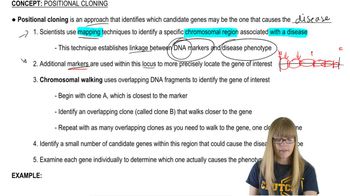
Step 1: Begin by identifying the chromosomal location of the dunce and rutabaga genes. This can be achieved using genetic mapping techniques such as recombination frequency analysis or deficiency mapping in Drosophila. These methods help narrow down the region of the genome where the genes are located.
Step 2: Use molecular markers or known sequences near the mapped region to design probes for isolating the DNA. These probes can be used in techniques like in situ hybridization or Southern blotting to confirm the presence of the target genes in the identified region.
Step 3: Construct a genomic library from Drosophila DNA. This involves fragmenting the entire genome into smaller pieces and inserting these fragments into vectors (e.g., bacterial artificial chromosomes or plasmids) for propagation in host cells such as E. coli.
Step 4: Screen the genomic library using the probes designed earlier to identify clones containing the dunce and rutabaga genes. Hybridization techniques can be employed to detect the presence of the target sequences in the library clones.
Step 5: Once the clones containing the genes are identified, sequence the DNA to confirm the identity of the dunce and rutabaga genes. Further analysis, such as functional studies or expression profiling, can be performed to validate their roles in the genetic pathways described by Seymour Benzer's laboratory.

Verified video answer for a similar problem:

This video solution was recommended by our tutors as helpful for the problem above.
Video duration:
2m
Was this helpful?

Key Concepts

Here are the essential concepts you must grasp in order to answer the question correctly.

Gene Cloning

Gene cloning is a molecular biology technique used to create copies of a specific gene. This process typically involves isolating the gene of interest, inserting it into a vector (like a plasmid), and introducing this vector into a host organism, where it can be replicated. Understanding the steps of gene cloning is essential for manipulating and studying specific genes, such as the dunce and rutabaga genes in Drosophila.
Recommended video:
Guided course
07:
Positional Cloning

Drosophila Genetics

Drosophila melanogaster, commonly known as the fruit fly, is a model organism widely used in genetic research due to its simple genome and short life cycle. The study of Drosophila genetics allows researchers to explore gene function, inheritance patterns, and the effects of mutations. Familiarity with Drosophila's genetic tools, such as P-element transposons and RNA interference, is crucial for effectively cloning and analyzing specific genes.
Recommended video:
Guided course
09:03
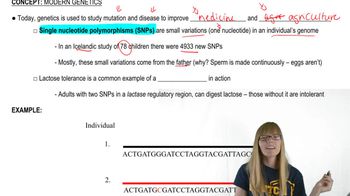
Modern Genetics

Seymour Benzer's Genetic Screen

Seymour Benzer's genetic screen was a pioneering method that identified specific genes responsible for behavior and learning in Drosophila. By inducing mutations and observing phenotypic changes, Benzer was able to link genetic variations to specific traits. Understanding the context of this genetic screen is vital for identifying the dunce and rutabaga genes, as it provides insight into their roles and the methodologies used to isolate them.
Recommended video:
Guided course
03:45
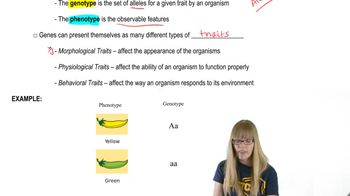
Descriptive Genetics
Related Practice
Textbook Question

How would you design a genetic screen to find genes involved in meiosis?

807
views
Textbook Question

The eyes of Drosophila develop from imaginal discs, groups of cells set aside in the fly embryo that differentiate into the adult structures during the pupal stage. Despite their importance in nature, eyes are dispensable for fruit fly life in the laboratory.

Devise a genetic screen to identify genes directing the development of the fly eye.

465
views
Textbook Question

The eyes of Drosophila develop from imaginal discs, groups of cells set aside in the fly embryo that differentiate into the adult structures during the pupal stage. Despite their importance in nature, eyes are dispensable for fruit fly life in the laboratory.

What complications might arise from genetic screens targeting an organ that differentiates late in development?

411
views
Textbook Question

Mutations in the CFTR gene result in cystic fibrosis in humans, a condition in which abnormal secretions are present in the lungs, pancreas, and sweat glands. The gene was mapped to a 500-kb region on chromosome 7 containing three candidate genes.

Using your knowledge of the disease symptoms, how would you distinguish between the candidate genes to decide which is most likely to encode the CFTR gene?

708
views
Textbook Question

Mutations in the CFTR gene result in cystic fibrosis in humans, a condition in which abnormal secretions are present in the lungs, pancreas, and sweat glands. The gene was mapped to a 500-kb region on chromosome 7 containing three candidate genes.

How would you prove that your chosen candidate is the CFTR gene?

850
views
Textbook Question

How would you clone a gene that you have identified by a mutant phenotype in Drosophila?

745
views