Pearson+ LogoPearson+ Logo
Ch. 14 - Analysis of Gene Function via Forward Genetics and Reverse Genetics
Sanders - Genetic Analysis: An Integrated Approach 3rd Edition
Sanders3rd EditionGenetic Analysis: An Integrated ApproachISBN: 9780135564172Not the one you use?Change textbook
Chapter 14, Problem 23b

Mutations in the CFTR gene result in cystic fibrosis in humans, a condition in which abnormal secretions are present in the lungs, pancreas, and sweat glands. The gene was mapped to a 500-kb region on chromosome 7 containing three candidate genes.
How would you prove that your chosen candidate is the CFTR gene?

Verified step by step guidance
1
Identify the candidate gene's sequence and compare it to the sequence of the CFTR gene in individuals with and without cystic fibrosis. Look for mutations or variations that are consistently present in individuals with the disease but absent in unaffected individuals.
Perform functional studies by expressing the candidate gene in a model system (e.g., cultured cells) to determine if it produces a protein with the expected function of CFTR, such as chloride ion transport.
Use genetic linkage analysis to confirm that the candidate gene co-segregates with the cystic fibrosis phenotype in affected families. This involves analyzing whether the gene's mutations are inherited along with the disease in family pedigrees.
Conduct knockout or knockdown experiments in animal models (e.g., mice) to observe whether disrupting the candidate gene results in symptoms similar to cystic fibrosis, such as abnormal lung or pancreatic function.
Rescue the phenotype by introducing a normal copy of the candidate gene into a model organism or cell line with the mutation. If the normal gene restores function, it provides strong evidence that the candidate gene is responsible for the disease.

Verified video answer for a similar problem:

This video solution was recommended by our tutors as helpful for the problem above.
Video duration:
1m
Was this helpful?

Key Concepts

Here are the essential concepts you must grasp in order to answer the question correctly.

CFTR Gene Function

The CFTR (Cystic Fibrosis Transmembrane Conductance Regulator) gene encodes a protein that functions as a channel for chloride ions across epithelial cell membranes. This regulation of ion transport is crucial for maintaining the balance of salt and water in various tissues, particularly in the lungs and pancreas. Mutations in this gene disrupt normal ion flow, leading to the thick, sticky mucus characteristic of cystic fibrosis.
Recommended video:
Guided course
08:26
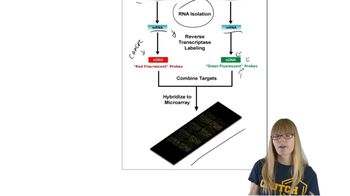
Functional Genomics

Genetic Mutations

Genetic mutations are alterations in the DNA sequence that can lead to changes in protein function. In the context of cystic fibrosis, specific mutations in the CFTR gene can cause the protein to be misfolded or nonfunctional. Understanding the types of mutations (e.g., missense, nonsense, deletions) is essential for identifying the genetic basis of the disease and proving the involvement of the CFTR gene.
Recommended video:
Guided course
10:48
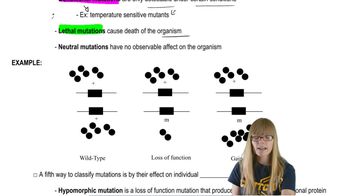
Mutations and Phenotypes

Gene Mapping and Candidate Gene Identification

Gene mapping involves locating genes on chromosomes and identifying their functions. In this case, the CFTR gene was mapped to a specific region on chromosome 7, which contains several candidate genes. To prove that a candidate gene is CFTR, researchers can use techniques such as genetic linkage analysis, sequencing, and functional assays to demonstrate that mutations in this gene correlate with cystic fibrosis symptoms.
Recommended video:
Guided course
09:09
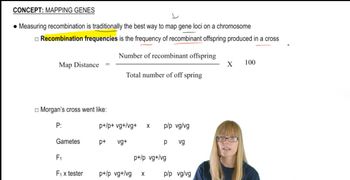
Mapping Genes
Related Practice
Textbook Question

The eyes of Drosophila develop from imaginal discs, groups of cells set aside in the fly embryo that differentiate into the adult structures during the pupal stage. Despite their importance in nature, eyes are dispensable for fruit fly life in the laboratory.

What complications might arise from genetic screens targeting an organ that differentiates late in development?

411
views
Textbook Question

Given your knowledge of the genetic tools for studying Drosophila, outline a method by which you could clone the dunce and rutabaga genes identified by Seymour Benzer's laboratory in the genetic screen.

520
views
Textbook Question

Mutations in the CFTR gene result in cystic fibrosis in humans, a condition in which abnormal secretions are present in the lungs, pancreas, and sweat glands. The gene was mapped to a 500-kb region on chromosome 7 containing three candidate genes.

Using your knowledge of the disease symptoms, how would you distinguish between the candidate genes to decide which is most likely to encode the CFTR gene?

708
views
Textbook Question

How would you clone a gene that you have identified by a mutant phenotype in Drosophila?

745
views
Textbook Question

How would you conduct a screen to identify recessive mutations in Drosophila that result in embryo lethality? How would you propagate the recessive mutant alleles?

445
views
Textbook Question

In land plants, there is an alternation of generations between a haploid gametophyte generation and a diploid sporophytic generation. Both generations are typically multicellular and may be free-living. The male (pollen) and female (embryo sac) gametophytes are the haploid generation of flowering plants.

How would you conduct a screen to identify genes required for female gametophyte development in Arabidopsis?

661
views