Pearson+ LogoPearson+ Logo
Ch. 15 - Recombinant DNA Technology and Its Applications
Sanders - Genetic Analysis: An Integrated Approach 3rd Edition
Sanders3rd EditionGenetic Analysis: An Integrated ApproachISBN: 9780135564172Not the one you use?Change textbook
Chapter 15, Problem 16

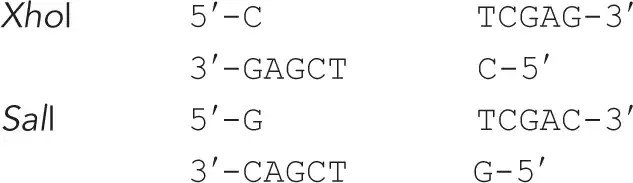
The restriction enzymes XhoI and SalI cut their specific sequences as shown below:
Restriction enzymes XhoI and SalI sequences with their sticky ends and potential ligation outcomes.
Can the sticky ends created by XhoI and SalI sites be ligated? If yes, can the resulting sequences be cleaved by either XhoI or SalI?

Verified step by step guidance
1
Step 1: Understand the concept of sticky ends. Sticky ends are single-stranded overhangs created when restriction enzymes cut DNA at specific recognition sites. These overhangs can pair with complementary sequences, allowing DNA fragments to be ligated together.
Step 2: Analyze the sequences cut by XhoI and SalI. XhoI cuts at 5'-CTCGAG-3' and leaves a sticky end with the sequence 5'-TCGA-3'. SalI cuts at 5'-GTCGAC-3' and leaves a sticky end with the sequence 5'-TCGA-3'. Notice that both enzymes produce identical sticky ends (5'-TCGA-3').
Step 3: Determine if ligation is possible. Since the sticky ends produced by XhoI and SalI are identical, they can pair and be ligated together using DNA ligase. This is because complementary base pairing occurs between the overhangs.
Step 4: Examine the resulting sequence after ligation. When the sticky ends are ligated, the resulting sequence will contain the joined DNA fragments. However, the ligation may disrupt the recognition sites for XhoI and SalI, depending on the orientation of the ligated fragments.
Step 5: Assess cleavage by XhoI or SalI. After ligation, check if the recognition sites for XhoI (5'-CTCGAG-3') or SalI (5'-GTCGAC-3') are restored. If the ligation alters the sequence such that the recognition sites are no longer present, the resulting DNA cannot be cleaved by either enzyme.

Verified video answer for a similar problem:

This video solution was recommended by our tutors as helpful for the problem above.
Video duration:
2m
Was this helpful?

Key Concepts

Here are the essential concepts you must grasp in order to answer the question correctly.

Restriction Enzymes

Restriction enzymes, or restriction endonucleases, are proteins that cut DNA at specific sequences, known as recognition sites. Each enzyme recognizes a unique sequence of nucleotides and cleaves the DNA, often producing 'sticky' or 'blunt' ends. Understanding how these enzymes work is crucial for genetic engineering, as they allow for the manipulation of DNA fragments for cloning or other applications.
Recommended video:
Guided course
07:11
Mapping with Markers

Sticky Ends

Sticky ends are short, single-stranded overhangs that are created when restriction enzymes cut DNA in a staggered manner. These overhangs can easily anneal with complementary sequences, facilitating the ligation of different DNA fragments. The ability to ligate DNA fragments with sticky ends is fundamental in recombinant DNA technology, allowing for the creation of new genetic combinations.
Recommended video:
Guided course
07:39
Genetic Cloning

Ligation and Cleavage

Ligation is the process of joining two DNA fragments together, typically using the enzyme DNA ligase, which forms covalent bonds between the sugar-phosphate backbones. After ligation, the resulting DNA can be tested for susceptibility to cleavage by the original restriction enzymes. If the ligated sequence contains the recognition sites for either enzyme, it can be cleaved again, which is important for verifying successful cloning or modification.
Recommended video:
Guided course
04:30
Post Translational Modifications
Related Practice
Textbook Question
A major advance in the 1980s was the development of technology to synthesize short oligonucleotides. This work both facilitated DNA sequencing and led to the advent of the development of PCR. Recently, rapid advances have occurred in the technology to chemically synthesize DNA, and sequences up to 10 kb are now readily produced. As this process becomes more economical, how will it affect the gene-cloning approaches outlined in this chapter? In other words, what types of techniques does this new technology have potential to supplant, and what techniques will not be affected by it?
728
views
Textbook Question

The bacteriophage lambda genome can exist in either a linear form or a circular form.

How many fragments will be formed by restriction enzyme digestion with XhoI alone, with XbaI alone, and with both XhoI and XbaI in the linear and circular forms of the lambda genome?

674
views
Textbook Question

The bacteriophage lambda genome can exist in either a linear form or a circular form.

Diagram the resulting fragments as they would appear on an agarose gel after electrophoresis.

453
views
Textbook Question

The bacteriophage ϕX174 has a single-stranded DNA genome of 5386 bases. During DNA replication, double-stranded forms of the genome are generated. In an effort to create a restriction map of ϕX174, you digest the z-stranded form of the genome with several restriction enzymes and obtain the following results. Draw a map of the ϕX174 genome.

645
views
Textbook Question

To further analyze the CRABS CLAW gene, you create a map of the genomic clone. The 11-kb EcoRI fragment is ligated into the EcoRI site of the MCS of the vector shown in Problem 18. You digest the double-stranded form of the genome with several restriction enzymes and obtain the following results. Draw, as far as possible, a map of the genomic clone of CRABS CLAW.

What restriction digest would help resolve any ambiguity in the map?

436
views
Textbook Question

You have isolated a genomic clone with an EcoRI fragment of 11 kb that encompasses the CRABS CLAW gene. You digest the genomic clone with HindIII and note that the 11-kb EcoRI fragment is split into three fragments of 9 kb, 1.5 kb, and 0.5 kb.

Does this tell you anything about where the CRABS CLAW gene is located within the 11-kb genomic clone?

612
views