Pearson+ LogoPearson+ Logo
Ch. 15 - Recombinant DNA Technology and Its Applications
Sanders - Genetic Analysis: An Integrated Approach 3rd Edition
Sanders3rd EditionGenetic Analysis: An Integrated ApproachISBN: 9780135564172Not the one you use?Change textbook
Chapter 15, Problem 27a

You have identified an enhancer trap line generated by P element transposition in Drosophila in which the marker gene from the enhancer trap is specifically expressed in the wing imaginal disc.
How can you identify the gene adjacent to the insertion site of the enhancer trap?

Verified step by step guidance
1
Step 1: Extract genomic DNA from the Drosophila line containing the enhancer trap. This will provide the DNA surrounding the P element insertion site.
Step 2: Perform inverse PCR (Polymerase Chain Reaction) to amplify the DNA flanking the P element insertion. Inverse PCR involves digesting the genomic DNA with a restriction enzyme, circularizing the fragments, and then using primers specific to the P element to amplify the flanking regions.
Step 3: Sequence the PCR product obtained from inverse PCR. This will reveal the DNA sequence adjacent to the P element insertion site.
Step 4: Use bioinformatics tools to compare the sequenced DNA to the Drosophila genome database. This will help identify the gene or genomic region adjacent to the enhancer trap insertion site.
Step 5: Validate the identified gene by analyzing its expression pattern in the wing imaginal disc using techniques such as RNA in situ hybridization or reporter assays to confirm its association with the enhancer trap activity.

Verified video answer for a similar problem:

This video solution was recommended by our tutors as helpful for the problem above.
Video duration:
4m
Was this helpful?

Key Concepts

Here are the essential concepts you must grasp in order to answer the question correctly.

Enhancer Trap

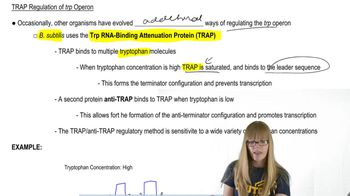
An enhancer trap is a genetic tool used to study gene expression by inserting a reporter gene into the genome. This insertion allows researchers to identify and visualize the activity of nearby enhancers, which are regulatory DNA sequences that increase the likelihood of transcription of specific genes. In Drosophila, enhancer traps can reveal spatial and temporal patterns of gene expression, particularly in developmental contexts like the wing imaginal disc.
Recommended video:
Guided course
03:21
Alternative trp regulation

P Element Transposition

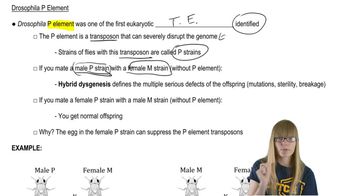
P element transposition refers to the movement of P elements, which are a type of transposable element, within the Drosophila genome. These elements can insert themselves into various locations, including near genes, and can disrupt or modify gene function. Understanding P element transposition is crucial for identifying the genetic context of enhancer traps, as the location of the insertion can provide insights into the regulation of adjacent genes.
Recommended video:
Guided course
03:08
Drosophila P Element

Gene Mapping Techniques

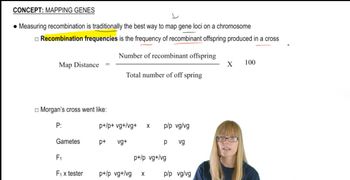
Gene mapping techniques are methods used to determine the location of genes on chromosomes. In the context of identifying the gene adjacent to an enhancer trap insertion, techniques such as PCR amplification, sequencing, and in situ hybridization can be employed. These methods help researchers pinpoint the exact location of the enhancer trap and the nearby genes, facilitating the study of their functions and interactions in developmental processes.
Recommended video:
Guided course
09:09
Mapping Genes
Related Practice
Textbook Question

In Drosophila, loss-of-function Ultrabithorax mutations result in the posterior thoracic segments differentiating into body parts with an identity normally found in the anterior thoracic segments. When the Ultrabithorax gene was cloned, it was shown to encode a transcription factor and to be expressed only in the posterior region of the thorax. Thus, Ultrabithorax acts to specify the identity of the posterior thoracic segments. Similar genes were soon discovered in other animals, including mice and humans. You have found that mice possess two closely related genes, Hoxa7 and Hoxb4, which are orthologs of Ultrabithorax. You wish to know whether the two mouse genes act to specify the identity of body segments in mice.

How will you determine where and when the mouse genes are expressed?

419
views
Textbook Question

In Drosophila, loss-of-function Ultrabithorax mutations result in the posterior thoracic segments differentiating into body parts with an identity normally found in the anterior thoracic segments. When the Ultrabithorax gene was cloned, it was shown to encode a transcription factor and to be expressed only in the posterior region of the thorax. Thus, Ultrabithorax acts to specify the identity of the posterior thoracic segments. Similar genes were soon discovered in other animals, including mice and humans. You have found that mice possess two closely related genes, Hoxa7 and Hoxb4, which are orthologs of Ultrabithorax. You wish to know whether the two mouse genes act to specify the identity of body segments in mice.

How will you create loss-of-function alleles of the mouse genes?

400
views
Textbook Question

In Drosophila, loss-of-function Ultrabithorax mutations result in the posterior thoracic segments differentiating into body parts with an identity normally found in the anterior thoracic segments. When the Ultrabithorax gene was cloned, it was shown to encode a transcription factor and to be expressed only in the posterior region of the thorax. Thus, Ultrabithorax acts to specify the identity of the posterior thoracic segments. Similar genes were soon discovered in other animals, including mice and humans. You have found that mice possess two closely related genes, Hoxa7 and Hoxb4, which are orthologs of Ultrabithorax. You wish to know whether the two mouse genes act to specify the identity of body segments in mice.

How will you determine whether the mouse genes have redundant functions?

543
views
Textbook Question

You have identified an enhancer trap line generated by P element transposition in Drosophila in which the marker gene from the enhancer trap is specifically expressed in the wing imaginal disc.

How would you show that the expression pattern of the enhancer trap line reflects the endogenous gene expression pattern of the adjacent gene?

568
views
Textbook Question

The highlighted sequence shown below is the one originally used to produce the B chain of human insulin in E. coli. The sequence of the human gene encoding the B chain of insulin was later determined from a cDNA isolated from a human pancreatic cDNA library and is also shown below, without highlighting. Explain the differences between the two sequences.

ATGTTCGTCAATCAGCACCTTTGTGGTTCTCACCTCGTTGAAGCTTTGTACCTTGTTTGCGGTGAACGTGGTTTCTTCTACACTCCTAAGACTTAA

GCCTTTGTGAACCAACACCTGTGCGGCTCACACCTGGTGGAAGCTCTCTACCTAGTGTGCGGGGAACGAGGCTTCTTCTACACACCCAAGACCCGC

650
views
Textbook Question

Vitamin E is the name for a set of chemically related tocopherols, which are lipid-soluble compounds with antioxidant properties. Such antioxidants protect cells against the effects of free radicals created as by-products of energy metabolism in the mitochondrion. Different tocopherols have different biological activities due to differences in their retention by binding to gut proteins during digestion. The one retained at the highest level is α-tocopherol, whereas γ-tocopherol is retained at less than 10% of that efficiency. In Arabidopsis, α-tocopherol is the most abundant tocopherol in leaves, whereas γ-tocopherol is the most abundant in seeds. An enzyme encoded by the VTE4 gene can convert γ-tocopherol to α-tocopherol. How would you create an Arabidopsis plant that produces high levels of α-tocopherol in the seeds?

512
views