Using the two-hybrid system to detect interactions between proteins, you obtained the following results: A clone encoding gene A gave positive results with clones B and C; clone B gave positive results with clones A, D, and E but not C; and clone E gave positive results only with clone B. Another clone F gave positive results with clone G but not with any of A–E. Can you explain these results? To follow up your two-hybrid results, you isolate null loss-of-function mutations in each of the genes A–G. Mutants of genes A, B, C, D, and E grow at only 80% of the rate of the wild type, whereas mutants of genes F and G are phenotypically indistinguishable from the wild type. You construct several double-mutant strains: The ab, ac, ad, and ae double mutants all grow at about 80% of the rate of the wild type, but af and ag double mutants exhibit lethality. Explain these results. How do the two-hybrid system and genetic interaction results complement one another? Can you reconcile your two-hybrid system and genetic interaction results in a single model?
Ch. 16 - Genomics: Genetics from a Whole-Genome Perspective

Sanders3rd EditionGenetic Analysis: An Integrated ApproachISBN: 9780135564172
Not the one you use?Change textbookSelect a different textbook
Table of contents
- Ch. 1 - The Molecular Basis of Heredity, Variation, and Evolution64
- Ch. 2 - Transmission Genetics144
- Ch. 3 - Cell Division and Chromosome Heredity81
- Ch. 4 - Gene Interaction87
- Ch. 5 - Genetic Linkage and Mapping in Eukaryotes103
- Ch. 6 - Genetic Analysis and Mapping in Bacteria and Bacteriophages73
- Ch. 7 - DNA Structure and Replication71
- Ch. 8 - Molecular Biology of Transcription and RNA Processing79
- Ch. 9 - The Molecular Biology of Translation110
- Ch. 10 - Eukaryotic Chromosome Abnormalities and Molecular Organization100
- Ch. 11 - Gene Mutation, DNA Repair, and Homologous Recombination86
- Ch. 12 - Regulation of Gene Expression in Bacteria and Bacteriophage90
- Ch. 13 - Regulation of Gene Expression in Eukaryotes38
- Ch. 14 - Analysis of Gene Function via Forward Genetics and Reverse Genetics72
- Ch. 15 - Recombinant DNA Technology and Its Applications69
- Ch. 16 - Genomics: Genetics from a Whole-Genome Perspective49
- Ch. 17 - Organelle Inheritance and the Evolution of Organelle Genomes27
- Ch. 18 - Developmental Genetics43
- Ch. 19 - Genetic Analysis of Quantitative Traits66
- Ch. 20 - Population Genetics and Evolution at the Population, Species, and Molecular Levels105
Sanders3rd EditionGenetic Analysis: An Integrated ApproachISBN: 9780135564172Not the one you use?Change textbook
All textbooks Sanders 3rd EditionCh. 16 - Genomics: Genetics from a Whole-Genome PerspectiveProblem 33
Sanders 3rd EditionCh. 16 - Genomics: Genetics from a Whole-Genome PerspectiveProblem 33Chapter 16, Problem 33
Describe how enhancer screens can be used to uncover genetic redundancy.
 Verified step by step guidance
1
Understand the concept of genetic redundancy: Genetic redundancy occurs when multiple genes perform similar or overlapping functions, so the loss of one gene does not result in a significant phenotype due to compensation by other genes.
Learn about enhancer screens: Enhancer screens are genetic experiments designed to identify mutations that exacerbate or enhance a phenotype caused by a primary mutation. These screens help uncover interactions between genes and pathways.
Design the enhancer screen: Start with an organism or cell line that has a mild phenotype due to a mutation in a gene of interest. Introduce random mutations across the genome using mutagenic agents (e.g., chemicals or radiation). Look for individuals where the phenotype becomes more severe, indicating potential genetic interactions.
Analyze the results: Identify the secondary mutations that enhance the phenotype. These mutations may reveal genes that are functionally redundant with the gene of interest, as their disruption exacerbates the phenotype.
Validate genetic redundancy: Perform further experiments, such as double mutant analysis, to confirm that the identified genes are redundant. For example, create organisms with mutations in both the primary gene and the enhancer gene to observe if the phenotype is more severe than either mutation alone.
Verified video answer for a similar problem:
This video solution was recommended by our tutors as helpful for the problem above.

Video duration:
1mKey Concepts
Here are the essential concepts you must grasp in order to answer the question correctly.
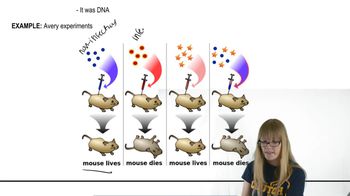
Enhancer Screens
Enhancer screens are experimental techniques used in genetics to identify genes that can compensate for the loss of function of another gene. By introducing mutations or deletions in specific genes and observing the phenotypic outcomes, researchers can determine if other genes can 'enhance' or restore the function, revealing potential genetic interactions and redundancies.
Recommended video:
Guided course
 09:32
09:32
History and Experiments
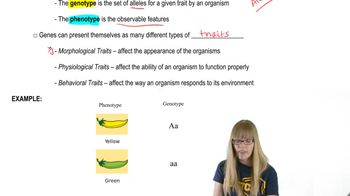
Genetic Redundancy
Genetic redundancy occurs when multiple genes perform similar functions, allowing an organism to maintain normal biological processes even if one gene is mutated or nonfunctional. This phenomenon can complicate genetic analysis, as the effects of a single gene knockout may be masked by the activity of redundant genes, making it challenging to identify essential genetic pathways.
Recommended video:
Guided course
 03:45
03:45Descriptive Genetics
Phenotypic Analysis
Phenotypic analysis involves studying the observable traits or characteristics of an organism resulting from the interaction of its genotype with the environment. In the context of enhancer screens, phenotypic analysis helps researchers assess the impact of genetic modifications, allowing them to identify compensatory mechanisms and elucidate the roles of redundant genes in various biological processes.
Recommended video:
Guided course
 02:48
02:48Chi Square Analysis
Related Practice
Textbook Question
527
views
Textbook Question
Describe at least two mechanisms by which duplicate genes arise. What are the possible fates of duplicate genes? Does the mode of duplication affect possible fates?
659
views
Textbook Question
What is the difference between biochemical and biological function?
802
views