Pearson+ LogoPearson+ Logo
Ch. 17 - Organelle Inheritance and the Evolution of Organelle Genomes
Sanders - Genetic Analysis: An Integrated Approach 3rd Edition
Sanders3rd EditionGenetic Analysis: An Integrated ApproachISBN: 9780135564172Not the one you use?Change textbook
Chapter 17, Problem 15

Consider this human pedigree for a vision defect.
Human pedigree chart illustrating a vision defect inheritance pattern.
What is the most probable mode of inheritance of the disease? Identify any discrepancies between the pedigree and your proposed mode of transmission, and provide possible explanations for these exceptions. 

Verified step by step guidance
1
Examine the pedigree chart carefully. Note that affected individuals are represented by filled symbols (squares for males and circles for females), while unaffected individuals are represented by unfilled symbols.
Determine whether the disease is inherited in an autosomal dominant, autosomal recessive, X-linked dominant, or X-linked recessive manner. Consider patterns such as whether the disease appears in every generation (dominant) or skips generations (recessive).
Analyze the gender distribution of affected individuals. If males and females are equally affected, the inheritance is likely autosomal. If males are predominantly affected, consider X-linked inheritance.
Identify any discrepancies in the inheritance pattern. For example, if an affected parent has unaffected children, this could suggest incomplete penetrance or a new mutation.
Propose possible explanations for exceptions, such as incomplete penetrance, variable expressivity, or environmental factors influencing the phenotype. Ensure the mode of inheritance aligns with the majority of the pedigree data.

Verified video answer for a similar problem:

This video solution was recommended by our tutors as helpful for the problem above.
Video duration:
3m
Was this helpful?

Key Concepts

Here are the essential concepts you must grasp in order to answer the question correctly.

Modes of Inheritance

Modes of inheritance describe how genetic traits are passed from parents to offspring. The primary modes include autosomal dominant, autosomal recessive, X-linked dominant, and X-linked recessive. Understanding these patterns helps in predicting the likelihood of a trait appearing in future generations, which is crucial for analyzing pedigrees.
Recommended video:
Guided course
05:13
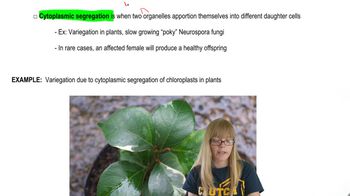
Organelle Inheritance

Pedigree Analysis

Pedigree analysis is a method used to trace the inheritance of traits through generations in a family tree format. Symbols represent individuals and their phenotypes, with squares for males and circles for females. By examining the relationships and affected individuals, one can infer the mode of inheritance and identify potential carriers of genetic conditions.
Recommended video:
Guided course
01:59
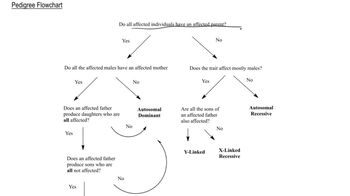
Pedigree Flowchart

Discrepancies in Inheritance Patterns

Discrepancies in inheritance patterns occur when observed traits in a pedigree do not align with expected genetic inheritance models. These can arise from factors such as incomplete penetrance, variable expressivity, or new mutations. Identifying these discrepancies is essential for understanding the complexity of genetic traits and providing accurate genetic counseling.
Recommended video:
Guided course
05:13
Organelle Inheritance
Related Practice
Textbook Question

What type or types of inheritance are consistent with the following pedigree? 

507
views
Textbook Question

You have isolated (1) a streptomycin-resistant mutant (strᴿ) of Chlamydomonas that maps to the chloroplast genome and (2) a hygromycin-resistant mutant (hygᴿ) of Chlamydomonas that maps to the mitochondrial genome. What types of progeny do you expect from the following reciprocal crosses?


mt⁺ strᴿ hygˢ× mt⁻ strˢ hygᴿ

mt⁺ strˢ hygᴿ× mt⁻ strᴿ hygSˢ

434
views
Textbook Question

You have isolated two petite mutants, pet1 and pet2, in Saccharomyces cerevisiae. When pet1 is mated with wild-type yeast, the haploid products following meiosis segregate 2:2 (wild type : petite). In contrast, when pet2 is mated with wild type, all haploid products following meiosis are wild type. To what class of petite mutations does each of these petite mutants belong? What types of progeny do you expect from a pet1 × pet2 mating?

372
views
Textbook Question

A 50-year-old man has been diagnosed with MELAS syndrome. His wife is phenotypically normal, and there is no history of MELAS syndrome in either of their families. The couple is concerned about whether their children will develop the disease. As a genetic counselor, what will you tell them? Would your answer change if it were the mother who exhibited disease symptoms rather than the father?

411
views
Textbook Question

The first person in a family to exhibit Leber hereditary optic neuropathy (LHON) was II-3 in the pedigree shown below, and all of her children also exhibited the disease. Provide two possible explanations as to why II-3's mother (I-1) did not exhibit symptoms of LHON.

563
views
Textbook Question

The following pedigree shows a family in which several individuals exhibit symptoms of the mitochondrial disease MERRF. Two siblings (II-2 and II-5) approach you to inquire about whether their children will also be afflicted with MERRF. What do you tell them? 

1092
views