Pearson+ LogoPearson+ Logo
Ch. 17 - Organelle Inheritance and the Evolution of Organelle Genomes
Sanders - Genetic Analysis: An Integrated Approach 3rd Edition
Sanders3rd EditionGenetic Analysis: An Integrated ApproachISBN: 9780135564172Not the one you use?Change textbook
Chapter 17, Problem 3

The human mitochondrial genome encodes only 22 tRNAs, but at least 32 tRNAs are needed for cytoplasmic translation. How are all codons in mitochondrial transcripts accommodated by only 22 tRNAs? The Plasmodium mitochondrial genome does not encode any tRNAs; how are genes of the Plasmodium mitochondrial genome translated?

Verified step by step guidance
1
Understand the problem: The human mitochondrial genome encodes only 22 tRNAs, which is fewer than the 32 tRNAs required for cytoplasmic translation. Additionally, the Plasmodium mitochondrial genome does not encode any tRNAs. The question asks how translation is accomplished in these cases.
Step 1: Recognize the concept of 'wobble base pairing.' In mitochondria, the genetic code is slightly different from the standard code, and fewer tRNAs are required because of relaxed base-pairing rules at the third position of the codon. This allows one tRNA to recognize multiple codons.
Step 2: Explain how human mitochondria accommodate translation with only 22 tRNAs. The wobble hypothesis enables a single tRNA to pair with multiple codons that differ only at the third nucleotide position. This reduces the number of tRNAs needed for translation.
Step 3: Address the Plasmodium mitochondrial genome. Since it does not encode any tRNAs, translation of mitochondrial genes relies on importing tRNAs from the cytoplasm. These tRNAs are synthesized in the cytoplasm and transported into the mitochondria to facilitate translation.
Step 4: Summarize the key mechanisms: Human mitochondria use wobble base pairing to reduce the number of required tRNAs, while Plasmodium mitochondria import tRNAs from the cytoplasm to compensate for the lack of encoded tRNAs.

Verified video answer for a similar problem:

This video solution was recommended by our tutors as helpful for the problem above.
Video duration:
2m
Was this helpful?

Key Concepts

Here are the essential concepts you must grasp in order to answer the question correctly.

Mitochondrial Genome and tRNA

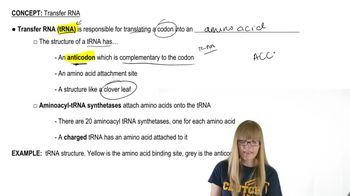
The mitochondrial genome is a small, circular DNA molecule found in mitochondria, encoding essential proteins and tRNAs for mitochondrial function. In humans, it encodes only 22 tRNAs, which are responsible for translating mitochondrial mRNA into proteins. This limited number of tRNAs is compensated by the ability of some tRNAs to recognize multiple codons due to wobble base pairing, allowing for efficient translation despite the apparent shortage.
Recommended video:

Codon Usage and Wobble Hypothesis

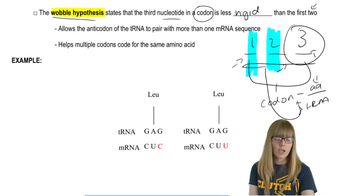
The wobble hypothesis explains how the third position of a codon can pair with multiple tRNA anticodons, allowing a single tRNA to recognize more than one codon. This flexibility is crucial in mitochondrial translation, where the limited number of tRNAs can still accommodate the full range of codons. This mechanism enables the translation of mitochondrial transcripts despite the fewer tRNAs available.
Recommended video:
Guided course
03:13
Translation:Wobble Hypothesis

Translation in Plasmodium Mitochondria

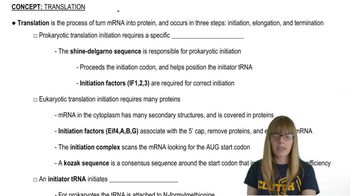
In Plasmodium, the organism responsible for malaria, the mitochondrial genome does not encode any tRNAs. Instead, translation of mitochondrial genes is facilitated by importing tRNAs from the cytoplasm. This adaptation allows Plasmodium to effectively translate its mitochondrial proteins without relying on its own tRNA synthesis, showcasing a unique evolutionary strategy.
Recommended video:
Guided course
07:58
Translation initiation