Textbook Question
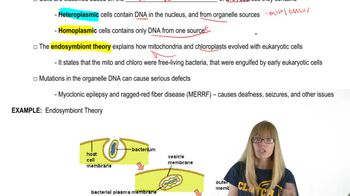
Outline the steps required for a gene originally present in the endosymbiont genome to be transferred to the nuclear genome and be expressed, and for its product to be targeted back to the organelle of origin.
521
views

 Sanders 3rd EditionCh. 17 - Organelle Inheritance and the Evolution of Organelle GenomesProblem 5
 Verified step by step guidance
 04:29
04:29
 04:11
04:11 09:03
09:03Outline the steps required for a gene originally present in the endosymbiont genome to be transferred to the nuclear genome and be expressed, and for its product to be targeted back to the organelle of origin.
What is the evidence that transfer of DNA from the organelles to the nucleus continues to occur?
How are some of the characteristics of the organelles (the mitochondria and chloroplasts) explained by their origin as ancient bacterial endosymbionts?
What are the differences between the universal code and that found in the mitochondria of some species? Given that some changes (UGA =stop→Trp) have occurred multiple independent times in evolution, can you think of any selective advantage to the mitochondrial code?
What is the evidence that the ancient mitochondrial and chloroplast endosymbionts are related to the alphaproteobacteria and cyanobacteria, respectively?
The human mitochondrial genome encodes only 22 tRNAs, but at least 32 tRNAs are needed for cytoplasmic translation. How are all codons in mitochondrial transcripts accommodated by only 22 tRNAs? The Plasmodium mitochondrial genome does not encode any tRNAs; how are genes of the Plasmodium mitochondrial genome translated?