Pearson+ LogoPearson+ Logo
Ch. 17 - Organelle Inheritance and the Evolution of Organelle Genomes
Sanders - Genetic Analysis: An Integrated Approach 3rd Edition
Sanders3rd EditionGenetic Analysis: An Integrated ApproachISBN: 9780135564172Not the one you use?Change textbook
Chapter 17, Problem 4

What is the evidence that transfer of DNA from the organelles to the nucleus continues to occur?

Verified step by step guidance
1
Understand that organelles like mitochondria and chloroplasts have their own DNA, which is separate from the nuclear DNA.
Recognize that over evolutionary time, some genes originally present in organelle DNA have been transferred to the nuclear genome.
Consider the presence of nuclear genes that are homologous to organelle genes, indicating past transfer events.
Look for ongoing evidence of DNA transfer by identifying nuclear genes that are similar to organelle genes but have slight differences, suggesting recent transfer.
Examine experimental studies that show the movement of DNA from organelles to the nucleus in living cells, providing direct evidence of ongoing transfer.

Verified video answer for a similar problem:

This video solution was recommended by our tutors as helpful for the problem above.
Video duration:
4m
Was this helpful?

Key Concepts

Here are the essential concepts you must grasp in order to answer the question correctly.

Endosymbiotic Theory

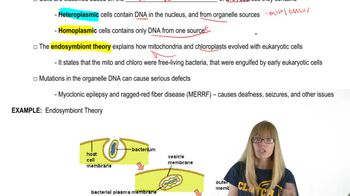
The endosymbiotic theory posits that mitochondria and chloroplasts originated from free-living prokaryotes that were engulfed by ancestral eukaryotic cells. This theory explains the presence of their own DNA, which is similar to bacterial DNA, suggesting a historical transfer of genetic material. Understanding this theory is crucial for grasping how organelles may transfer DNA to the nucleus.
Recommended video:
Guided course
04:11
Organelle DNA Characteristics

Horizontal Gene Transfer

Horizontal gene transfer (HGT) refers to the movement of genetic material between organisms other than through traditional reproduction. In the context of organelles, HGT can occur when DNA from mitochondria or chloroplasts is integrated into the nuclear genome, providing evidence of ongoing genetic exchange. This concept is essential for understanding how organelle DNA can influence nuclear function.
Recommended video:
Guided course
09:09
Mapping Genes

Nuclear-Organelle Interactions

Nuclear-organelle interactions involve the communication and genetic exchange between the nucleus and organelles like mitochondria and chloroplasts. These interactions are vital for cellular function, as they regulate processes such as energy production and metabolic pathways. Evidence of DNA transfer from organelles to the nucleus highlights the dynamic relationship between these cellular components.
Recommended video:
Guided course
05:13
Organelle Inheritance
Related Practice
Textbook Question

Reciprocal crosses of experimental animals or plants sometimes give different results in the F1. What are two possible genetic explanations? How would you distinguish between these two possibilities (i.e., what crosses would you perform, and what would the results tell you)?

714
views
Textbook Question

How are some of the characteristics of the organelles (the mitochondria and chloroplasts) explained by their origin as ancient bacterial endosymbionts?

448
views
Textbook Question

The human mitochondrial genome encodes only 22 tRNAs, but at least 32 tRNAs are needed for cytoplasmic translation. How are all codons in mitochondrial transcripts accommodated by only 22 tRNAs? The Plasmodium mitochondrial genome does not encode any tRNAs; how are genes of the Plasmodium mitochondrial genome translated?

813
views
Textbook Question

Draw a graph depicting the relative amounts of nuclear DNA present in the different stages of the cell cycle (G₁,S,G₂,M). On the same graph, plot the amount of mitochondrial DNA present at each stage of the cell cycle.

469
views
Textbook Question

What are the differences between the universal code and that found in the mitochondria of some species? Given that some changes (UGA =stop→Trp) have occurred multiple independent times in evolution, can you think of any selective advantage to the mitochondrial code?

789
views
Textbook Question

What is the evidence that the ancient mitochondrial and chloroplast endosymbionts are related to the alphaproteobacteria and cyanobacteria, respectively?

552
views