
Textbook Question
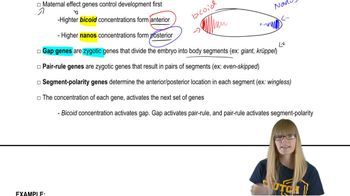
The bristles that develop from the epidermis in Drosophila are evenly spaced, so that two bristles never occur immediately adjacent to each other. How might this pattern be established during development?
466
views

 Verified step by step guidance
 11:19
11:19 11:19
11:19 07:56
07:56In contrast to Drosophila, some insects (e.g., centipedes) have legs on almost every segment posterior to the head. Based on your knowledge of Drosophila, propose a genetic explanation for this phenotype, and describe the expected expression patterns of genes of the Antennapedia and bithorax complexes.
The pair-rule gene fushi tarazu is expressed in the seven even-numbered parasegments during Drosophila embryogenesis. In contrast, the segment polarity gene engrailed is expressed in the anterior part of each of the 14 parasegments. Since both genes are active at similar times and places during development, it is possible that the expression of one gene is required for the expression of the other. This can be tested by examining the expression of the genes in a mutant background—for example, looking at fushi tarazu expression in an engrailed mutant background, and vice versa. Based on your prediction, can you predict the phenotype of the fushi tarazu and engrailed double mutant?
The bicoid gene is a coordinate maternal–effect gene. If loss of bicoid function in the egg leads to lethality during embryogenesis, how are females homozygous for bicoid produced? What is the phenotype of a male homozygous for bicoid loss-of-function alleles?
Given that maternal Bicoid activates the expression of hunchback, what would be the consequence of adding extra copies of the bicoid gene by transgenic means to a wild-type female with two copies, thus creating a female fly with three or four copies of the bicoid gene? How would the hunchback expression be altered? What about the expression of other gap genes and pair-rule genes?