Pearson+ LogoPearson+ Logo
Ch. 19 - Genetic Analysis of Quantitative Traits
Sanders - Genetic Analysis: An Integrated Approach 3rd Edition
Sanders3rd EditionGenetic Analysis: An Integrated ApproachISBN: 9780135564172Not the one you use?Change textbook
Chapter 19, Problem 9

Why is heritability an important phenomenon in plant and animal agriculture?

Verified step by step guidance
1
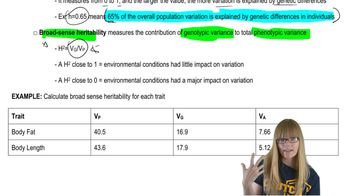
Heritability is a measure of how much of the variation in a trait within a population is due to genetic differences among individuals, as opposed to environmental factors.
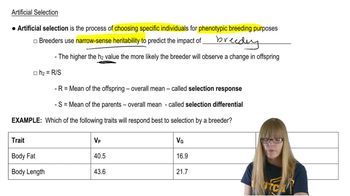
In plant and animal agriculture, heritability helps breeders predict the potential for a trait to be passed on to the next generation, which is crucial for selective breeding programs.
High heritability indicates that a trait is largely influenced by genetics, making it more likely that selective breeding will result in offspring with the desired traits.
Low heritability suggests that environmental factors play a larger role in the expression of the trait, meaning that selective breeding may have limited success in improving that trait.
Understanding heritability allows agricultural scientists to optimize breeding strategies, improve crop yields, enhance livestock productivity, and develop traits such as disease resistance or drought tolerance.

Verified video answer for a similar problem:

This video solution was recommended by our tutors as helpful for the problem above.
Video duration:
1m
Was this helpful?

Key Concepts

Here are the essential concepts you must grasp in order to answer the question correctly.

Heritability

Heritability is a measure of how much of the variation in a trait can be attributed to genetic differences among individuals in a population. It is expressed as a proportion, ranging from 0 to 1, where a higher value indicates a greater genetic influence. Understanding heritability helps breeders select traits that can be reliably passed on to future generations.
Recommended video:
Guided course
07:04
Calculating Heritability

Selective Breeding

Selective breeding is a process used in agriculture to enhance desirable traits in plants and animals. By choosing parents with specific characteristics, breeders can increase the frequency of these traits in the offspring. This practice relies on the principles of heritability to ensure that the selected traits are genetically stable and can be effectively propagated.
Recommended video:
Guided course
04:15
Artificial Selection

Genetic Variation

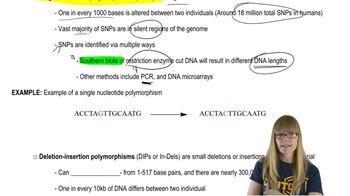
Genetic variation refers to the diversity in gene frequencies within a population. It is essential for evolution and adaptation, as it provides the raw material for natural selection. In agriculture, maintaining genetic variation is crucial for developing resilient crops and livestock that can withstand diseases, pests, and changing environmental conditions.
Recommended video:
Guided course
09:28
Genomic Variation
Related Practice
Textbook Question

Provide a definition and an example for each of the following terms:

Quantitative trait locus

410
views
Textbook Question

Provide a definition and an example for each of the following terms:

Threshold trait

452
views
Textbook Question

What is a random sample, and why can a random sample be used to represent a population?

583
views
Textbook Question

Three pairs of genes with two alleles each (A₁ and A₂, B₁ and B₂, and C₁ and C₂) control the height of a plant. The alleles of these genes have an additive relationship: Each copy of alleles A₁, B₁, and C₁ contributes 6 cm to plant height, and each copy of alleles A₂, B₂, and C₂ contributes 3 cm.

What are the expected heights of plants with each of the homozygous genotypes A₁A₁B₁B₁C₁C₁ and A₂A₂B₂B₂C₂C₂? 

521
views
Textbook Question

Three pairs of genes with two alleles each (A₁ and A₂, B₁ and B₂, and C₁ and C₂) control the height of a plant. The alleles of these genes have an additive relationship: Each copy of alleles A₁, B₁, and C₁ contributes 6 cm to plant height, and each copy of alleles A₂, B₂, and C₂ contributes 3 cm. What height is expected in the F₁ progeny of a cross between A₁A₁B₁B₁C₁C₁ and A₂A₂B₂B₂C₂C₂?

409
views
Textbook Question

Three pairs of genes with two alleles each (A₁ and A₂, B₁ and B₂, and C₁ and C₂) control the height of a plant. The alleles of these genes have an additive relationship: Each copy of alleles A₁, B₁, and C₁ contributes 6 cm to plant height, and each copy of alleles A₂, B₂, and C₂ contributes 3 cm. What is the expected height of a plant with the genotype A₁A₂B₂B₂C₁C₂?

512
views