Pearson+ LogoPearson+ Logo
Ch. 19 - Genetic Analysis of Quantitative Traits
Sanders - Genetic Analysis: An Integrated Approach 3rd Edition
Sanders3rd EditionGenetic Analysis: An Integrated ApproachISBN: 9780135564172Not the one you use?Change textbook
Chapter 19, Problem 7e

Provide a definition and an example for each of the following terms:
Quantitative trait locus

Verified step by step guidance
1
A quantitative trait locus (QTL) is a region of the genome that is associated with a quantitative trait, which is a trait that varies continuously and is influenced by multiple genes and environmental factors. Examples of quantitative traits include height, weight, and crop yield.
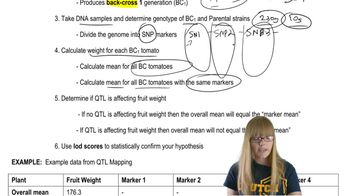
To identify a QTL, researchers typically use statistical methods to link variations in DNA markers (such as SNPs or microsatellites) with variations in the quantitative trait of interest.
An example of a QTL study could involve mapping regions of the genome associated with plant height in a population of hybrid plants. By analyzing the genetic markers and their correlation with height measurements, researchers can identify specific genomic regions that contribute to height variation.
QTLs are often identified using techniques such as linkage mapping or genome-wide association studies (GWAS), which involve analyzing the inheritance patterns of traits in a population.
Understanding QTLs is important for applications such as selective breeding in agriculture, where identifying genomic regions associated with desirable traits can help improve crop or livestock characteristics.

Verified video answer for a similar problem:

This video solution was recommended by our tutors as helpful for the problem above.
Video duration:
2m
Was this helpful?

Key Concepts

Here are the essential concepts you must grasp in order to answer the question correctly.

Quantitative Trait Locus (QTL)

A Quantitative Trait Locus (QTL) is a specific region of DNA that is associated with a particular quantitative trait, which is a measurable phenotype that varies continuously, such as height or weight. QTLs are identified through statistical analysis of phenotypic data and genetic markers, allowing researchers to understand the genetic basis of complex traits.
Recommended video:

Phenotype

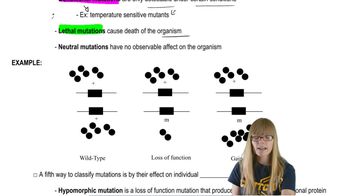
Phenotype refers to the observable characteristics or traits of an organism, which result from the interaction of its genotype (genetic makeup) with the environment. Examples of phenotypes include physical attributes like color, size, and shape, as well as behavioral traits. Understanding phenotypes is crucial for studying QTLs, as they are the traits that QTLs influence.
Recommended video:
Guided course
10:48
Mutations and Phenotypes

Genetic Markers

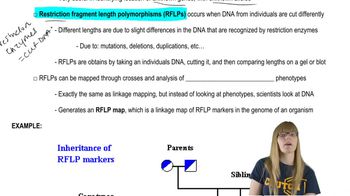
Genetic markers are specific sequences in the genome that can be used to identify individuals or species and track inheritance patterns. They serve as reference points in genetic mapping studies, including QTL mapping, where they help researchers correlate specific regions of the genome with phenotypic traits. Common types of genetic markers include single nucleotide polymorphisms (SNPs) and microsatellites.
Recommended video:
Guided course
07:11
Mapping with Markers