Pearson+ LogoPearson+ Logo
Ch. 2 - Transmission Genetics
Sanders - Genetic Analysis: An Integrated Approach 3rd Edition
Sanders3rd EditionGenetic Analysis: An Integrated ApproachISBN: 9780135564172Not the one you use?Change textbook
Chapter 2, Problem 48b

A pea plant that has the genotype RrGgwwdd is crossed to a plant that has the rrGgWwDd genotype. The R gene controls round versus wrinkled seed, the G gene controls yellow versus green seed, the W gene controls purple versus white flower, and the D gene controls tall versus short plants. Determine the following;


What proportion of the progeny are expected to have the genotype RrGGwwDd?

Verified step by step guidance
1
Identify the genotypes of the parent plants: The first parent has the genotype RrGgwwdd, and the second parent has the genotype rrGgWwDd. Each gene is inherited independently, so we will analyze each gene separately using the rules of Mendelian inheritance.
Determine the inheritance pattern for the R gene: The first parent is Rr (heterozygous), and the second parent is rr (homozygous recessive). Use a Punnett square to determine the possible offspring genotypes for this gene. The possible outcomes are Rr and rr, each with a probability of 1/2.
Determine the inheritance pattern for the G gene: Both parents are Gg (heterozygous). Use a Punnett square to determine the possible offspring genotypes for this gene. The possible outcomes are GG (1/4), Gg (1/2), and gg (1/4).
Determine the inheritance pattern for the W gene: The first parent is ww (homozygous recessive), and the second parent is Ww (heterozygous). Use a Punnett square to determine the possible offspring genotypes for this gene. The possible outcomes are Ww (1/2) and ww (1/2).
Determine the inheritance pattern for the D gene: The first parent is dd (homozygous recessive), and the second parent is Dd (heterozygous). Use a Punnett square to determine the possible offspring genotypes for this gene. The possible outcomes are Dd (1/2) and dd (1/2). Multiply the probabilities for each gene to find the proportion of progeny with the genotype RrGGwwDd: (1/2 for Rr) × (1/4 for GG) × (1/2 for ww) × (1/2 for Dd).

Verified video answer for a similar problem:

This video solution was recommended by our tutors as helpful for the problem above.
Video duration:
3m
Was this helpful?

Key Concepts

Here are the essential concepts you must grasp in order to answer the question correctly.

Genotype and Phenotype

The genotype refers to the genetic makeup of an organism, represented by alleles (e.g., Rr, Gg). The phenotype is the observable physical or biochemical characteristics resulting from the genotype. Understanding the relationship between genotype and phenotype is crucial for predicting traits in offspring.
Recommended video:
Guided course
07:52
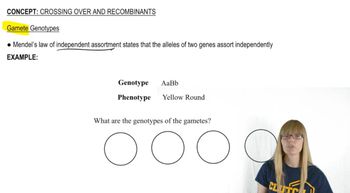
Gamete Genotypes

Punnett Square

A Punnett square is a diagram used to predict the genetic outcomes of a cross between two organisms. It helps visualize the combination of alleles from each parent, allowing for the calculation of the expected proportions of different genotypes and phenotypes in the progeny.
Recommended video:
Guided course
18:27
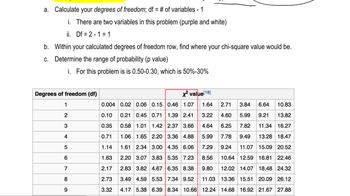
Chi Square Analysis

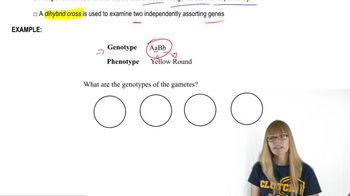
Independent Assortment

Independent assortment is a principle of genetics stating that alleles for different traits segregate independently during gamete formation. This means that the inheritance of one trait does not affect the inheritance of another, which is essential for calculating the probabilities of multiple traits in offspring.
Recommended video:
Guided course
04:58
Gamete Genetics and Independent Assortment
Related Practice
Textbook Question

The accompanying pedigree shows a family in which one child (II-1) has an autosomal recessive condition. On the basis of this fact alone, provide the following information.

What is the probability that all three of the children in generation II who have the dominant phenotype are Aa?

913
views
Textbook Question

The accompanying pedigree shows a family in which one child (II-1) has an autosomal recessive condition. On the basis of this fact alone, provide the following information.

What is the chance that among the three children in generation II who have the dominant phenotype, one of them is AA and two of them are Aa? (Hint: Consider all possible orders of genotypes.)

978
views
Textbook Question

A pea plant that has the genotype RrGgwwdd is crossed to a plant that has the rrGgWwDd genotype. The R gene controls round versus wrinkled seed, the G gene controls yellow versus green seed, the W gene controls purple versus white flower, and the D gene controls tall versus short plants. Determine the following;


What are the phenotypes of each plant?

575
views
Textbook Question

A pea plant that has the genotype RrGgwwdd is crossed to a plant that has the rrGgWwDd genotype. The R gene controls round versus wrinkled seed, the G gene controls yellow versus green seed, the W gene controls purple versus white flower, and the D gene controls tall versus short plants. Determine the following;


What proportion of the progeny are expected to have the genotype rrggwwdd?

486
views
Textbook Question

A pea plant that has the genotype RrGgwwdd is crossed to a plant that has the rrGgWwDd genotype. The R gene controls round versus wrinkled seed, the G gene controls yellow versus green seed, the W gene controls purple versus white flower, and the D gene controls tall versus short plants. Determine the following:

What proportion of the progeny are expected to be round, yellow, purple, and tall?

495
views
Textbook Question

Go to the OMIM website (http://www.ncbi.nlm.nih.gov/omim) and locate the Search button at the top of the page. Use the search function to look up, one by one, the following three human hereditary diseases that are relatively common in certain populations: 'Tay–Sachs disease' (select OMIM number 272800 from the search results list); 'cystic fibrosis' (select OMIM number 602421 from the search results list); and 'sickle cell anemia' (select OMIM 603903 from the search results list). For each of these diseases, look through the information and provide the following details:

On which chromosome is the gene for the disease located?

605
views