Pearson+ LogoPearson+ Logo
Ch. 2 - Transmission Genetics
Sanders - Genetic Analysis: An Integrated Approach 3rd Edition
Sanders3rd EditionGenetic Analysis: An Integrated ApproachISBN: 9780135564172Not the one you use?Change textbook
Chapter 2, Problem 11a

Black skin color is dominant to pink skin color in pigs. Two heterozygous black pigs are crossed.
What is the probability that their offspring will have pink skin?

Verified step by step guidance
1
Step 1: Identify the genotypes of the parents. Since the black skin color is dominant and the pigs are heterozygous, their genotypes are Bb, where 'B' represents the dominant allele for black skin and 'b' represents the recessive allele for pink skin.
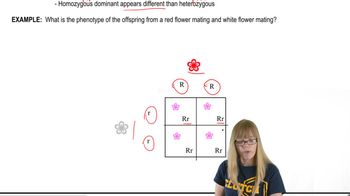
Step 2: Set up a Punnett square to determine the possible genotypes of the offspring. Place one parent's alleles (B and b) along the top of the square and the other parent's alleles (B and b) along the side.
Step 3: Fill in the Punnett square by combining the alleles from the top and side. The possible combinations are BB, Bb, Bb, and bb.
Step 4: Determine the phenotypes associated with each genotype. BB and Bb result in black skin (dominant trait), while bb results in pink skin (recessive trait).
Step 5: Calculate the probability of pink skin (bb genotype) by counting the number of bb combinations in the Punnett square and dividing by the total number of combinations (4).

Verified video answer for a similar problem:

This video solution was recommended by our tutors as helpful for the problem above.
Video duration:
1m
Was this helpful?

Key Concepts

Here are the essential concepts you must grasp in order to answer the question correctly.

Dominant and Recessive Alleles

In genetics, alleles are different forms of a gene. A dominant allele masks the effect of a recessive allele when both are present. In this case, black skin color is dominant over pink skin color, meaning that only one copy of the black allele is needed for the pig to exhibit black skin.
Recommended video:
Guided course
04:37
Variations on Dominance

Punnett Square

A Punnett square is a diagram used to predict the genetic outcomes of a cross between two organisms. By organizing the alleles of the parents, it allows for the visualization of possible genotypes and phenotypes of the offspring. For the cross of two heterozygous black pigs (Bb x Bb), the Punnett square helps determine the probability of each skin color in the offspring.
Recommended video:
Guided course
18:27
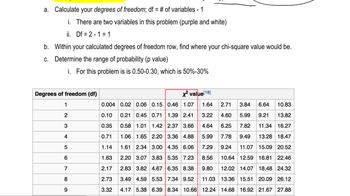
Chi Square Analysis

Genotype and Phenotype

The genotype refers to the genetic makeup of an organism, while the phenotype is the observable physical trait. In this scenario, the genotypes of the pigs (BB, Bb, or bb) will determine their phenotypes (black or pink skin). Understanding the relationship between genotype and phenotype is crucial for predicting the traits of the offspring.
Recommended video:
Guided course
07:52
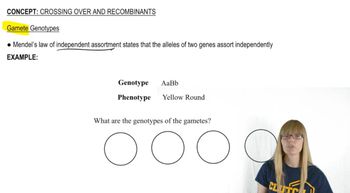
Gamete Genotypes
Related Practice
Textbook Question

The dorsal pigment pattern of frogs can be either 'leopard' (white pigment between dark spots) or 'mottled' (pigment between spots appears mottled). The trait is controlled by an autosomal gene. Males and females are selected from pure-breeding populations, and a pair of reciprocal crosses is performed. The cross results are shown below.

    Cross 1:  P₁: Male leopard x male mottled

             F₁: All mottled

             F₂: 70 mottled, 22 leopard

    Cross 2:  P₁: Male mottled x female leopard

             F₁: All mottled

             F₂: 50 mottled, 18 leopard

Compare and contrast the results of the reciprocal crosses in the context of autosomal gene inheritance.

509
views
Textbook Question

The dorsal pigment pattern of frogs can be either 'leopard' (white pigment between dark spots) or 'mottled' (pigment between spots appears mottled). The trait is controlled by an autosomal gene. Males and females are selected from pure-breeding populations, and a pair of reciprocal crosses is performed. The cross results are shown below.

    Cross 1:  P₁: Male leopard x male mottled

             F₁: All mottled

             F₂: 70 mottled, 22 leopard

    Cross 2:  P₁: Male mottled x female leopard

             F₁: All mottled

             F₂: 50 mottled, 18 leopard

In the F₂ progeny from both crosses, what proportion is expected to be homozygous? What proportion is expected to be heterozygous?

499
views
Textbook Question

The dorsal pigment pattern of frogs can be either 'leopard' (white pigment between dark spots) or 'mottled' (pigment between spots appears mottled). The trait is controlled by an autosomal gene. Males and females are selected from pure-breeding populations, and a pair of reciprocal crosses is performed. The cross results are shown below.

    Cross 1:  P₁: Male leopard x male mottled

             F₁: All mottled

             F₂: 70 mottled, 22 leopard

    Cross 2:  P₁: Male mottled x female leopard

             F₁: All mottled

             F₂: 50 mottled, 18 leopard

Propose two different genetic crosses that would allow you to determine the genotype of one mottled frog from the F₂ generation.

557
views
Textbook Question

Black skin color is dominant to pink skin color in pigs. Two heterozygous black pigs are crossed.

What is the probability that the first and second offspring will have black skin?

583
views
Textbook Question

Black skin color is dominant to pink skin color in pigs. Two heterozygous black pigs are crossed.

If these pigs produce a total of three piglets, what is the probability that two will be pink and one will be black?

595
views
Textbook Question

A male mouse with brown fur color is mated to two different female mice with black fur. Black female 1 produces a litter of 9 black and 7 brown pups. Black female 2 produces 14 black pups.

What is the mode of inheritance of black and brown fur color in mice?

525
views