Pearson+ LogoPearson+ Logo
Ch. 2 - Transmission Genetics
Sanders - Genetic Analysis: An Integrated Approach 3rd Edition
Sanders3rd EditionGenetic Analysis: An Integrated ApproachISBN: 9780135564172Not the one you use?Change textbook
Chapter 2, Problem 52b

In humans, the ability to bend the thumb back beyond vertical is called hitchhiker's thumb and is dominant to the inability to do so (OMIM 274200). Also, the presence of attached earlobes is recessive to unattached earlobes (OMIM 128900).
Using all available and willing members of your family, or members of another family if yours is not easily accessible, trace the transmission of both traits in a pedigree. Use allelic symbols H and h for the thumb and E and e for earlobes, and identify the genotypes for each family member as completely as possible. Bring the pedigree back to share with your group.

Verified step by step guidance
1
Step 1: Understand the traits and their inheritance patterns. Hitchhiker's thumb is dominant (allele H), while the inability to bend the thumb is recessive (allele h). Unattached earlobes are dominant (allele E), while attached earlobes are recessive (allele e).
Step 2: Gather information about the phenotypes of family members for both traits. For example, determine who has hitchhiker's thumb and who has unattached or attached earlobes.
Step 3: Assign possible genotypes based on the observed phenotypes. For dominant traits, individuals showing the trait could be homozygous dominant (HH or EE) or heterozygous (Hh or Ee). For recessive traits, individuals showing the trait must be homozygous recessive (hh or ee).
Step 4: Construct a pedigree chart. Use standard symbols: squares for males, circles for females, shading to indicate the presence of a trait, and lines to connect family members. Label each individual with their phenotype and inferred genotype.
Step 5: Analyze the pedigree to trace the inheritance of both traits across generations. Use Mendelian principles to confirm or refine the genotypes of family members based on their relationships and offspring phenotypes.

Verified video answer for a similar problem:

This video solution was recommended by our tutors as helpful for the problem above.
Video duration:
4m
Was this helpful?

Key Concepts

Here are the essential concepts you must grasp in order to answer the question correctly.

Dominant and Recessive Traits

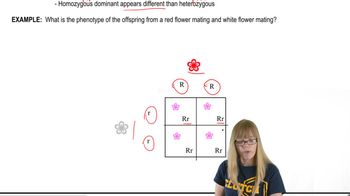
In genetics, traits can be classified as dominant or recessive based on their expression in an organism. A dominant trait, represented by a capital letter (e.g., H for hitchhiker's thumb), will manifest in the phenotype even if only one copy of the allele is present. In contrast, a recessive trait, denoted by a lowercase letter (e.g., e for attached earlobes), requires two copies of the allele to be expressed. Understanding this distinction is crucial for predicting inheritance patterns.
Recommended video:
Guided course
04:37
Variations on Dominance

Pedigree Analysis

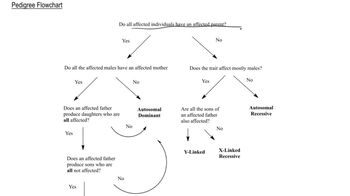
A pedigree is a diagram that depicts the genetic relationships and inheritance patterns within a family over generations. It uses standardized symbols to represent individuals and their traits, allowing for the visualization of how specific traits are passed down. Analyzing a pedigree helps in determining the genotypes of family members based on their phenotypes and the known dominance of traits, which is essential for understanding genetic inheritance.
Recommended video:
Guided course
01:59
Pedigree Flowchart

Genotype and Phenotype

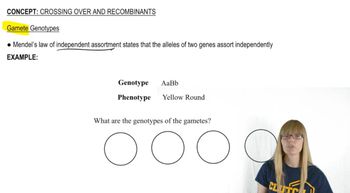
The genotype refers to the genetic makeup of an individual, specifically the alleles they carry for a particular trait, while the phenotype is the observable expression of that genotype. For example, an individual with the genotype HH or Hh will exhibit the hitchhiker's thumb phenotype, whereas only the genotype hh will result in the non-hitchhiker's thumb phenotype. Distinguishing between these concepts is vital for accurately interpreting genetic traits in a pedigree.
Recommended video:
Guided course
07:52
Gamete Genotypes
Related Practice
Textbook Question

For a number of human hereditary conditions, genetic testing is available to identify heterozygous carriers. Some heterozygous carrier testing programs are community-based, often as part of an organized effort targeting specific populations in which a disease and carriers of a disease are relatively frequent. For example, carrier genetic testing programs for Tay–Sachs disease target Ashkenazi Jewish populations and sickle cell disease carrier testing programs target African American populations. The testing is usually free or available at minimal cost, the wait time for results is short, and the results are confidential and unavailable to third parties such as insurance companies. Neither the Tay–Sachs nor the sickle cell allele produces serious consequences for heterozygous carriers.

In a broader sense, what is the value of a community-based effort targeting specific populations for selected diseases?

415
views
Textbook Question

For a number of human hereditary conditions, genetic testing is available to identify heterozygous carriers. Some heterozygous carrier testing programs are community-based, often as part of an organized effort targeting specific populations in which a disease and carriers of a disease are relatively frequent. For example, carrier genetic testing programs for Tay–Sachs disease target Ashkenazi Jewish populations and sickle cell disease carrier testing programs target African American populations. The testing is usually free or available at minimal cost, the wait time for results is short, and the results are confidential and unavailable to third parties such as insurance companies. Neither the Tay–Sachs nor the sickle cell allele produces serious consequences for heterozygous carriers.

Do you personally think you would participate in the kind of carrier genetic testing described if you were a member of a population targeted for such testing?

527
views
Textbook Question

In humans, the ability to bend the thumb back beyond vertical is called hitchhiker's thumb and is dominant to the inability to do so (OMIM 274200). Also, the presence of attached earlobes is recessive to unattached earlobes (OMIM 128900).

Check your own phenotype and those of several friends or classmates.

762
views