A woman, S.R., had a maternal grandfather with hemophilia A (OMIM 306700), an X-linked recessive condition that reduces blood clotting. S.R.'s maternal grandmother and paternal grandparents are free of the condition, as are her partner, his parents, and his grandparents. S.R. has no siblings. She wants to know the chance that a son of hers will have the condition. What is that probability?
Ch. 2 - Transmission Genetics

Sanders3rd EditionGenetic Analysis: An Integrated ApproachISBN: 9780135564172Not the one you use?Change textbook
Chapter 2, Problem A.4
A man, J.B., has a sister with autosomal recessive galactosemia (OMIM 230400), and his partner, S.B., has a brother with galactosemia. Galactosemia is a serious condition caused by an enzyme deficiency that prevents the metabolism of the sugar galactose. Neither J.B. nor S.B. has galactosemia, but they are concerned about the risk that a future child of theirs will have the condition. What is the probability their first child will have galactosemia?
Verified step by step guidance1
Step 1: Understand the inheritance pattern of galactosemia. Since galactosemia is described as an autosomal recessive disorder, a child must inherit two copies of the mutant allele (one from each parent) to be affected.
Step 2: Determine the genotypes of J.B. and S.B. based on the family history. J.B. has a sister with galactosemia, so both of J.B.'s parents must be carriers. This means J.B. has a 2/3 chance of being a carrier (heterozygous) because he does not have the disease himself. Similarly, S.B. has a brother with galactosemia, so S.B. also has a 2/3 chance of being a carrier.
Step 3: Calculate the probability that both J.B. and S.B. are carriers by multiplying their individual carrier probabilities: .
Step 4: If both parents are carriers, the probability that their child will have galactosemia is 1/4, because each parent can pass either the normal or mutant allele with equal probability.
Step 5: Multiply the probability that both parents are carriers by the probability that two carriers have an affected child: . This gives the overall probability that their first child will have galactosemia.

Verified video answer for a similar problem:
This video solution was recommended by our tutors as helpful for the problem above.
Video duration:
3mWas this helpful?
Key Concepts
Here are the essential concepts you must grasp in order to answer the question correctly.
Autosomal Recessive Inheritance
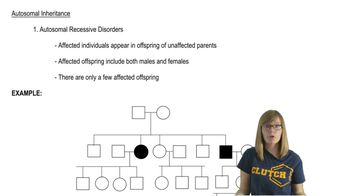
Autosomal recessive inheritance means a person must inherit two copies of a mutated gene, one from each parent, to express the disease. Carriers have one mutated and one normal allele and typically do not show symptoms. If both parents are carriers, there is a 25% chance their child will inherit both mutated alleles and have the disease.
Recommended video:
Guided course
Autosomal Pedigrees
Carrier Probability and Family History
Family history helps estimate carrier status. Since J.B.'s sister and S.B.'s brother have galactosemia, their parents are likely carriers. J.B. and S.B. each have a chance of being carriers themselves, which affects the risk of passing the disease to their child. Calculating this probability requires understanding the inheritance pattern and family relationships.
Recommended video:
Guided course
Probability
Calculating Offspring Risk in Autosomal Recessive Disorders
To find the risk a child will have the disorder, multiply the probability each parent is a carrier by the 25% chance of affected offspring if both are carriers. This involves determining carrier probabilities from family history and applying Mendelian genetics to estimate the overall risk for the child.
Recommended video:
Guided course
Autosomal Pedigrees
Related Practice
Textbook Question
549
views
Textbook Question
A 40-year-old woman whose father had Huntington disease currently shows no symptoms of the disease. She is newly pregnant with her first child and seeks your best estimate of the chance her child will inherit the disease. What is your estimate and how did you arrive at it? (Hint: See Figure 4.11)
484
views
Textbook Question
Compare and contrast the following terms:
Dominant and Recessive
652
views