Pearson+ LogoPearson+ Logo
Ch. 2 - Transmission Genetics
Sanders - Genetic Analysis: An Integrated Approach 3rd Edition
Sanders3rd EditionGenetic Analysis: An Integrated ApproachISBN: 9780135564172Not the one you use?Change textbook
Chapter 2, Problem 50c

Select a human hereditary disease or condition you would like to know more about. Using the OMIM website (http://www.ncbi.nlm.nih.gov/omim), search for the disease and prepare a short synopsis of your findings. Include the following information:
Any available information about the population(s) in which the disease is most common.

Verified step by step guidance
1
Visit the OMIM (Online Mendelian Inheritance in Man) website at http://www.ncbi.nlm.nih.gov/omim.
Use the search bar on the OMIM homepage to enter the name of the hereditary disease or condition you are interested in. For example, you could search for 'Cystic Fibrosis' or 'Sickle Cell Anemia.'
Review the search results and select the most relevant entry for the disease. This will typically be the entry with the disease name as the title and a detailed description.
Read through the entry to gather information about the disease, including its genetic basis, inheritance pattern, and any specific populations in which the disease is most common. Look for sections discussing epidemiology or population studies.
Summarize your findings, ensuring you include details about the populations most affected by the disease, any genetic mutations associated with it, and its inheritance pattern. Be concise and focus on the key points provided in the OMIM entry.

Verified video answer for a similar problem:

This video solution was recommended by our tutors as helpful for the problem above.
Video duration:
3m
Was this helpful?

Key Concepts

Here are the essential concepts you must grasp in order to answer the question correctly.

Hereditary Diseases

Hereditary diseases are genetic disorders caused by abnormalities in an individual's DNA, which can be inherited from one or both parents. These conditions can result from mutations in single genes (monogenic disorders) or involve multiple genes and environmental factors (multifactorial disorders). Understanding the genetic basis of these diseases is crucial for diagnosis, treatment, and genetic counseling.
Recommended video:
Guided course
05:48
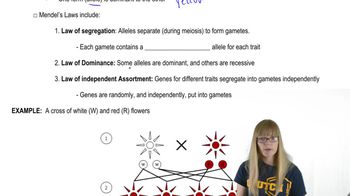
Mendel's Laws

OMIM Database

The Online Mendelian Inheritance in Man (OMIM) is a comprehensive, authoritative database that catalogs human genes and genetic disorders. It provides detailed information about the genetic basis, clinical features, and epidemiology of various hereditary conditions. Researchers and healthcare professionals use OMIM to access up-to-date information on genetic diseases, which aids in understanding their prevalence and inheritance patterns.
Recommended video:
Guided course
08:28
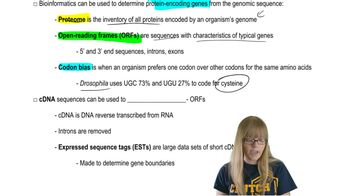
Bioinformatics

Population Genetics

Population genetics is the study of genetic variation within populations and how these variations change over time due to factors like natural selection, genetic drift, and gene flow. This field is essential for understanding the distribution of hereditary diseases among different populations, as certain genetic disorders may be more prevalent in specific ethnic or geographic groups due to historical, environmental, or social factors.
Recommended video:
Guided course
03:45
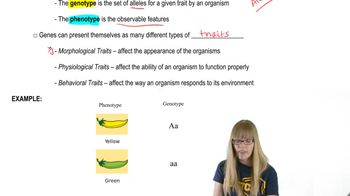
Descriptive Genetics
Related Practice
Textbook Question

Go to the OMIM website (http://www.ncbi.nlm.nih.gov/omim) and locate the Search button at the top of the page. Use the search function to look up, one by one, the following three human hereditary diseases that are relatively common in certain populations: 'Tay–Sachs disease' (select OMIM number 272800 from the search results list); 'cystic fibrosis' (select OMIM number 602421 from the search results list); and 'sickle cell anemia' (select OMIM 603903 from the search results list). For each of these diseases, look through the information and provide the following details:

In which population(s) does the disease most commonly occur?

438
views
Textbook Question

Select a human hereditary disease or condition you would like to know more about. Using the OMIM website (http://www.ncbi.nlm.nih.gov/omim), search for the disease and prepare a short synopsis of your findings. Include the following information:

The gene mutated in the disease and its chromosome location.

440
views
Textbook Question

Select a human hereditary disease or condition you would like to know more about. Using the OMIM website (http://www.ncbi.nlm.nih.gov/omim), search for the disease and prepare a short synopsis of your findings. Include the following information:

A description of the disease or condition.

415
views
Textbook Question

For a number of human hereditary conditions, genetic testing is available to identify heterozygous carriers. Some heterozygous carrier testing programs are community-based, often as part of an organized effort targeting specific populations in which a disease and carriers of a disease are relatively frequent. For example, carrier genetic testing programs for Tay–Sachs disease target Ashkenazi Jewish populations and sickle cell disease carrier testing programs target African American populations. The testing is usually free or available at minimal cost, the wait time for results is short, and the results are confidential and unavailable to third parties such as insurance companies. Neither the Tay–Sachs nor the sickle cell allele produces serious consequences for heterozygous carriers.

From a genetic perspective, what is the value of the information obtained by genetic testing of the type described?

479
views
Textbook Question

For a number of human hereditary conditions, genetic testing is available to identify heterozygous carriers. Some heterozygous carrier testing programs are community-based, often as part of an organized effort targeting specific populations in which a disease and carriers of a disease are relatively frequent. For example, carrier genetic testing programs for Tay–Sachs disease target Ashkenazi Jewish populations and sickle cell disease carrier testing programs target African American populations. The testing is usually free or available at minimal cost, the wait time for results is short, and the results are confidential and unavailable to third parties such as insurance companies. Neither the Tay–Sachs nor the sickle cell allele produces serious consequences for heterozygous carriers.

In a broader sense, what is the value of a community-based effort targeting specific populations for selected diseases?

415
views
Textbook Question

For a number of human hereditary conditions, genetic testing is available to identify heterozygous carriers. Some heterozygous carrier testing programs are community-based, often as part of an organized effort targeting specific populations in which a disease and carriers of a disease are relatively frequent. For example, carrier genetic testing programs for Tay–Sachs disease target Ashkenazi Jewish populations and sickle cell disease carrier testing programs target African American populations. The testing is usually free or available at minimal cost, the wait time for results is short, and the results are confidential and unavailable to third parties such as insurance companies. Neither the Tay–Sachs nor the sickle cell allele produces serious consequences for heterozygous carriers.

Do you personally think you would participate in the kind of carrier genetic testing described if you were a member of a population targeted for such testing?

527
views