Pearson+ LogoPearson+ Logo
Ch. 2 - Transmission Genetics
Sanders - Genetic Analysis: An Integrated Approach 3rd Edition
Sanders3rd EditionGenetic Analysis: An Integrated ApproachISBN: 9780135564172Not the one you use?Change textbook
Chapter 2, Problem 21a

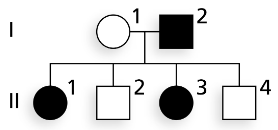
The accompanying pedigree shows the transmission of a phenotypic character. Using B to represent a dominant allele and b to represent a recessive allele,
Pedigree chart illustrating the inheritance of a phenotypic trait with symbols for dominant and recessive alleles.
Give the genotype(s) possible for each member of the family, assuming the trait is autosomal dominant. 

Verified step by step guidance
1
Examine the pedigree and identify individuals who express the autosomal dominant trait. These individuals must have at least one dominant allele (B).
Determine the genotype of individuals who do not express the trait. Since the trait is autosomal dominant, these individuals must be homozygous recessive (bb).
Analyze the inheritance pattern by considering the parents' genotypes and the phenotypes of their offspring. Use this information to deduce possible genotypes for each family member.
For individuals expressing the trait, consider whether they could be heterozygous (Bb) or homozygous dominant (BB). Use the offspring's phenotypes to narrow down the possibilities.
Assign possible genotypes (BB, Bb, or bb) to each family member based on the above analysis, ensuring consistency with the autosomal dominant inheritance pattern.

Verified video answer for a similar problem:

This video solution was recommended by our tutors as helpful for the problem above.
Video duration:
2m
Was this helpful?

Key Concepts

Here are the essential concepts you must grasp in order to answer the question correctly.

Autosomal Dominance

Autosomal dominance refers to a pattern of inheritance where only one copy of a dominant allele is needed for the trait to be expressed. In this case, individuals with at least one 'B' allele will display the dominant phenotype, while those with two 'b' alleles will exhibit the recessive phenotype. This concept is crucial for analyzing pedigrees, as it helps determine the possible genotypes of family members based on their phenotypes.
Recommended video:
Guided course
04:37
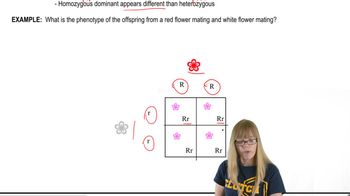
Variations on Dominance

Genotype vs. Phenotype

The genotype is the genetic makeup of an individual, represented by the alleles they possess (e.g., BB, Bb, or bb), while the phenotype is the observable expression of that genotype (e.g., dominant or recessive traits). Understanding the distinction between these two concepts is essential for interpreting the pedigree and deducing the genotypes of family members based on their phenotypic traits.
Recommended video:
Guided course
07:52
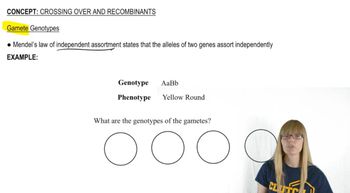
Gamete Genotypes

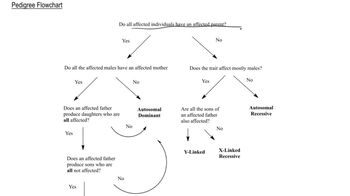
Pedigree Analysis

Pedigree analysis is a method used to trace the inheritance of traits through generations in a family. It involves constructing a diagram that represents family relationships and the presence or absence of specific traits. By analyzing the patterns of inheritance shown in the pedigree, one can infer the possible genotypes of individuals, especially in the context of dominant and recessive traits.
Recommended video:
Guided course
01:59
Pedigree Flowchart
Related Practice
Textbook Question

If two six-sided dice are rolled, what is the probability that the total number of spots showing is


greater than 5?

429
views
Textbook Question

If two six-sided dice are rolled, what is the probability that the total number of spots showing is


an odd number?

658
views
Textbook Question

Experimental Insight 2.1 describes data, collected by a genetics class like yours, on the numbers of kernels of different colors in bicolor corn. To test the hypothesis that the presence of kernels of different colors in each ear is the result of the segregation of two alleles of a single gene, the class counted 12,356 kernels and found that 9304 were yellow and 3052 were white. Use chi-square analysis to evaluate the fit between the segregation hypothesis and the class results.

480
views
Textbook Question

The accompanying pedigree shows the transmission of a phenotypic character. Using B to represent a dominant allele and b to represent a recessive allele,

Give the genotype(s) possible for each member of the family, assuming the trait is autosomal recessive. 

529
views
1
rank
Textbook Question

The seeds in bush bean pods are each the product of an independent fertilization event. Green seed color is dominant to white seed color in bush beans. If a heterozygous plant with green seeds self-fertilizes, what is the probability that 6 seeds in a single pod of the progeny plant will consist of 3 green and 3 white seeds?

454
views
Textbook Question

The seeds in bush bean pods are each the product of an independent fertilization event. Green seed color is dominant to white seed color in bush beans. If a heterozygous plant with green seeds self-fertilizes, what is the probability that 6 seeds in a single pod of the progeny plant will consist of all green seeds?

440
views