Pearson+ LogoPearson+ Logo
Ch. 2 - Transmission Genetics
Sanders - Genetic Analysis: An Integrated Approach 3rd Edition
Sanders3rd EditionGenetic Analysis: An Integrated ApproachISBN: 9780135564172Not the one you use?Change textbook
Chapter 2, Problem 19d

If two six-sided dice are rolled, what is the probability that the total number of spots showing is


an odd number?

Verified step by step guidance
1
Step 1: Understand the problem. We are rolling two six-sided dice and need to calculate the probability that the sum of the numbers showing on the dice is odd.
Step 2: Recall that the sum of two numbers is odd if one number is even and the other is odd. Therefore, we need to count all possible outcomes where one die shows an even number and the other die shows an odd number.
Step 3: Identify the even and odd numbers on a six-sided die. The even numbers are {2, 4, 6}, and the odd numbers are {1, 3, 5}. Each die has 3 even outcomes and 3 odd outcomes.
Step 4: Calculate the total number of outcomes when rolling two dice. Since each die has 6 faces, the total number of outcomes is 6 × 6 = 36.
Step 5: Determine the number of favorable outcomes. For each die, there are 3 even outcomes and 3 odd outcomes. Multiply the number of even outcomes on the first die by the number of odd outcomes on the second die (3 × 3), and vice versa (3 × 3). Add these two results to find the total number of favorable outcomes. Finally, divide the number of favorable outcomes by the total number of outcomes to find the probability.

Verified video answer for a similar problem:

This video solution was recommended by our tutors as helpful for the problem above.
Video duration:
1m
Was this helpful?

Key Concepts

Here are the essential concepts you must grasp in order to answer the question correctly.

Probability

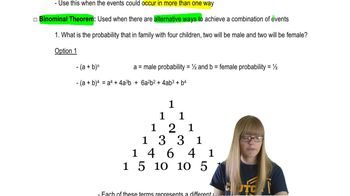
Probability is a measure of the likelihood that a particular event will occur, expressed as a number between 0 and 1. In this context, it involves calculating the chances of rolling two dice and obtaining an odd total. The probability can be determined by dividing the number of favorable outcomes by the total number of possible outcomes.
Recommended video:

Outcomes of Rolling Dice

When rolling two six-sided dice, each die has six faces, leading to a total of 36 possible outcomes (6 sides on the first die multiplied by 6 sides on the second die). Each outcome corresponds to a unique combination of the two dice, which can be used to analyze the sums that result from these combinations.
Recommended video:

Odd and Even Sums

The sum of two numbers is odd if one number is odd and the other is even. In the case of two dice, the possible sums range from 2 to 12. Understanding the distribution of odd and even sums is crucial for calculating the probability of obtaining an odd total when rolling the dice.
Recommended video:
Guided course
11:06
Mathematical Measurements