Pearson+ LogoPearson+ Logo
Ch. 20 - Population Genetics and Evolution at the Population, Species, and Molecular Levels
Sanders - Genetic Analysis: An Integrated Approach 3rd Edition
Sanders3rd EditionGenetic Analysis: An Integrated ApproachISBN: 9780135564172Not the one you use?Change textbook
Chapter 20, Problem 29b

A sample of 500 field mice contains 225 individuals that are D₁D₁, 175 that are D₁D₂, and 100 that are D₂D₂.
Is this population in H-W equilibrium? Use the chi-square test to justify your answer.

Verified step by step guidance
1
Step 1: Calculate the observed genotype frequencies. Divide the number of individuals for each genotype by the total population size (500). For example, the frequency of D₁D₁ is 225/500, D₁D₂ is 175/500, and D₂D₂ is 100/500.
Step 2: Determine the allele frequencies. Use the observed genotype counts to calculate the frequency of each allele (D₁ and D₂). For D₁, add twice the number of D₁D₁ individuals to the number of D₁D₂ individuals, then divide by twice the total population size. Similarly, calculate the frequency of D₂.
Step 3: Use the Hardy-Weinberg equilibrium formula to calculate the expected genotype frequencies. For D₁D₁, use p²; for D₁D₂, use 2pq; and for D₂D₂, use q², where p is the frequency of D₁ and q is the frequency of D₂. Multiply these frequencies by the total population size (500) to get the expected genotype counts.
Step 4: Perform the chi-square test. Use the formula χ² = Σ((O - E)² / E), where O represents the observed counts and E represents the expected counts for each genotype. Calculate the chi-square value by summing the contributions from D₁D₁, D₁D₂, and D₂D₂.
Step 5: Compare the calculated chi-square value to the critical value from a chi-square distribution table at the appropriate degrees of freedom (df = number of genotypes - 1 = 3 - 1 = 2) and significance level (commonly 0.05). If the chi-square value is less than the critical value, the population is in Hardy-Weinberg equilibrium; otherwise, it is not.

Verified video answer for a similar problem:

This video solution was recommended by our tutors as helpful for the problem above.
Video duration:
1m
Was this helpful?

Key Concepts

Here are the essential concepts you must grasp in order to answer the question correctly.

Hardy-Weinberg Equilibrium

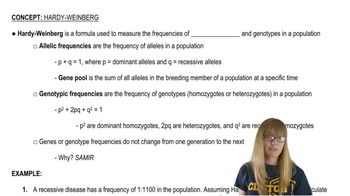
Hardy-Weinberg Equilibrium (HWE) is a principle that describes a population's genetic variation in the absence of evolutionary forces. For a population to be in HWE, it must meet five conditions: no mutations, random mating, no natural selection, extremely large population size, and no gene flow. If these conditions are met, allele and genotype frequencies will remain constant from generation to generation.
Recommended video:
Guided course
13:04
Hardy Weinberg

Chi-Square Test

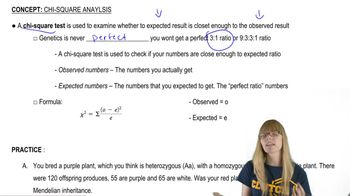
The Chi-Square Test is a statistical method used to determine if there is a significant difference between observed and expected frequencies in categorical data. In the context of HWE, it helps assess whether the observed genotype frequencies deviate from those expected under HWE. A high chi-square value indicates a significant difference, suggesting that the population may not be in equilibrium.
Recommended video:
Guided course
02:48
Chi Square Analysis

Genotype Frequencies

Genotype frequencies refer to the proportion of different genotypes within a population. In this case, the frequencies of D₁D₁, D₁D₂, and D₂D₂ genotypes can be calculated from the sample size. These frequencies are compared to the expected frequencies derived from allele frequencies under HWE to evaluate if the population is in equilibrium.
Recommended video:
Guided course
07:52
Gamete Genotypes
Related Practice
Textbook Question

ABO blood type is examined in a Taiwanese population, and allele frequencies are determined. In the population, f (Iᴬ) = 0.30, f (Iᴮ) = 0.15, and f (i) = 0.55.f. Assuming Hardy–Weinberg conditions apply, what are the frequencies of genotypes, and what are the blood group frequencies in this population?

510
views
Textbook Question
A total of 1000 members of a Central American population are typed for the ABO blood group. In the sample, 421 have blood type A, 168 have blood type B, 336 have blood type O, and 75 have blood type AB. Use this information to determine the frequency of ABO blood group alleles in the sample.
1006
views
Textbook Question

A sample of 500 field mice contains 225 individuals that are D₁D₁, 175 that are D₁D₂, and 100 that are D₂D₂.

What are the frequencies of D₁ and D₂ in this sample?

574
views
Textbook Question

A sample of 500 field mice contains 225 individuals that are D₁D₁, 175 that are D₁D₂, and 100 that are D₂D₂.

Is inbreeding a possible genetic explanation for the observed distribution of genotypes? Why or why not?

617
views
Textbook Question

In humans the presence of chin and cheek dimples is dominant to the absence of dimples, and the ability to taste the compound PTC is dominant to the inability to taste the compound. Both traits are autosomal, and they are unlinked. The frequencies of alleles for dimples are D = 0.62 and d = 0.38. For tasting, the allele frequencies are T = 0.76 and t = 0.24.

Determine the frequency of genotypes for each gene and the frequency of each phenotype.

523
views
Textbook Question

In humans the presence of chin and cheek dimples is dominant to the absence of dimples, and the ability to taste the compound PTC is dominant to the inability to taste the compound. Both traits are autosomal, and they are unlinked. The frequencies of alleles for dimples are D = 0.62 and d = 0.38. For tasting, the allele frequencies are T = 0.76 and t = 0.24.

What are the expected frequencies of the four possible phenotype combinations: dimpled tasters, undimpled tasters, dimpled nontasters, and undimpled nontasters?

471
views