Pearson+ LogoPearson+ Logo
Ch. 20 - Population Genetics and Evolution at the Population, Species, and Molecular Levels
Sanders - Genetic Analysis: An Integrated Approach 3rd Edition
Sanders3rd EditionGenetic Analysis: An Integrated ApproachISBN: 9780135564172Not the one you use?Change textbook
Chapter 20, Problem 42e

Put all the candies used in Problems 41 back into a single mound and then divide them into two piles, being sure that the frequencies of each color are the same in each pile. Make a note of the starting frequency of each color. Label one pile 'male' and the other pile 'female.'
Compare the starting frequency of each color with the frequency after drawing. Describe the observed differences and identify the evolutionary mechanism this exercise best emulates.

Verified step by step guidance
1
Step 1: Begin by gathering all the candies used in Problems 41 into a single mound. Ensure that you have recorded the starting frequency of each color. For example, if you have red, blue, and green candies, note the proportion of each color in the mound (e.g., 40% red, 30% blue, 30% green).
Step 2: Divide the mound into two equal piles, ensuring that the frequencies of each color are the same in both piles. This can be done by carefully counting and distributing the candies so that each pile has the same proportion of red, blue, and green candies as the original mound.
Step 3: Label one pile 'male' and the other pile 'female.' These labels will represent the two groups in the population for the purpose of this exercise.
Step 4: Simulate a drawing process where candies are randomly selected from each pile to form a new generation. Record the frequency of each color in the new generation after the drawing process. For example, if you draw candies randomly, the proportions may shift slightly due to chance.
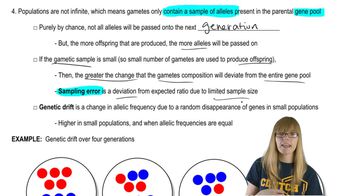
Step 5: Compare the starting frequency of each color with the frequency observed after the drawing process. Describe any differences in the frequencies and identify the evolutionary mechanism this exercise emulates. This exercise likely demonstrates genetic drift, which is the change in allele frequencies due to random sampling effects in small populations.

Verified video answer for a similar problem:

This video solution was recommended by our tutors as helpful for the problem above.
Video duration:
2m
Was this helpful?

Key Concepts

Here are the essential concepts you must grasp in order to answer the question correctly.

Genetic Drift

Genetic drift is a mechanism of evolution that refers to random changes in allele frequencies within a population. It is particularly significant in small populations, where chance events can lead to large fluctuations in genetic variation. This concept is crucial for understanding how certain traits may become more or less common over generations, independent of natural selection.
Recommended video:
Guided course
10:15
Genetic Drift

Allele Frequency

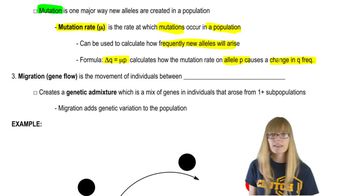
Allele frequency is the proportion of a specific allele among all allele copies in a population. It is a key measure in population genetics, as it helps to quantify genetic diversity and the genetic structure of populations. Tracking changes in allele frequencies over time can provide insights into evolutionary processes and mechanisms.
Recommended video:
Guided course
03:03
New Alleles and Migration

Sexual Selection

Sexual selection is a form of natural selection where individuals with certain inherited traits are more likely than others to obtain mates. This can lead to the development of secondary sexual characteristics and can influence allele frequencies in a population. Understanding sexual selection is essential for analyzing how reproductive strategies affect genetic diversity and evolutionary outcomes.
Recommended video:
Guided course
05:54
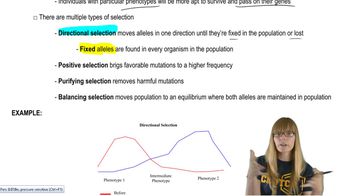
Natural Selection
Related Practice
Textbook Question

Put all the candies used in Problems 41 back into a single mound and then divide them into two piles, being sure that the frequencies of each color are the same in each pile. Make a note of the starting frequency of each color. Label one pile 'male' and the other pile 'female.'

If both colors drawn are yellow, eat the candies! If the two colors are any other combination, including yellow with any other color, put the candies back into their respective piles.

399
views
Textbook Question

Put all the candies used in Problems 41 back into a single mound and then divide them into two piles, being sure that the frequencies of each color are the same in each pile. Make a note of the starting frequency of each color. Label one pile 'male' and the other pile 'female.'

Repeat this process of blindly drawing one male and one female candy 12 to 15 times for each person in the group.

445
views
Textbook Question

Put all the candies used in Problems 41 back into a single mound and then divide them into two piles, being sure that the frequencies of each color are the same in each pile. Make a note of the starting frequency of each color. Label one pile 'male' and the other pile 'female.'

When all selection rounds have been completed, combine the two piles and determine the frequency of each color.

421
views
Textbook Question

There are usually five or more colors of candy in each bag. Sort the candies by color, and if your bag has more than four colors, eat the least frequent color or colors. Once that is done, calculate the frequencies of the four remaining colors. Assume these frequencies represent four alleles of a gene, and use the description of the H-W equilibrium for more than two alleles for assistance.

Using a different one of the following variables for each color frequency, write out the expected results of a quadrinomial expansion of the expression (p+q+r+t)².

703
views
Textbook Question

There are usually five or more colors of candy in each bag. Sort the candies by color, and if your bag has more than four colors, eat the least frequent color or colors. Once that is done, calculate the frequencies of the four remaining colors. Assume these frequencies represent four alleles of a gene, and use the description of the H-W equilibrium for more than two alleles for assistance.

Use this expansion to calculate the expected frequency of each possible genotype produced in a randomly mating population.

433
views