Pearson+ LogoPearson+ Logo
Ch. 20 - Population Genetics and Evolution at the Population, Species, and Molecular Levels
Sanders - Genetic Analysis: An Integrated Approach 3rd Edition
Sanders3rd EditionGenetic Analysis: An Integrated ApproachISBN: 9780135564172Not the one you use?Change textbook
Chapter 20, Problem 42b

Put all the candies used in Problems 41 back into a single mound and then divide them into two piles, being sure that the frequencies of each color are the same in each pile. Make a note of the starting frequency of each color. Label one pile 'male' and the other pile 'female.'
If both colors drawn are yellow, eat the candies! If the two colors are any other combination, including yellow with any other color, put the candies back into their respective piles.

Verified step by step guidance
1
Step 1: Start by determining the total number of candies for each color in the mound. Record the starting frequency of each color (e.g., yellow, red, etc.).
Step 2: Divide the candies into two piles ('male' and 'female') such that the frequency of each color is the same in both piles. For example, if there are 10 yellow candies, each pile should have 5 yellow candies.
Step 3: Randomly draw two candies from the piles. Note the colors of the candies drawn.
Step 4: If both candies drawn are yellow, eat the candies. If the candies are of any other combination (e.g., yellow and red, or red and red), return the candies to their respective piles.
Step 5: Repeat the process as needed, ensuring that the piles maintain equal frequencies of each color throughout the procedure.

Verified video answer for a similar problem:

This video solution was recommended by our tutors as helpful for the problem above.
Video duration:
1m
Was this helpful?

Key Concepts

Here are the essential concepts you must grasp in order to answer the question correctly.

Genetic Frequencies

Genetic frequencies refer to the proportion of different alleles or phenotypes in a population. In this context, it is crucial to maintain the same frequencies of each candy color (representing alleles) in both piles to ensure that the genetic representation remains consistent. This concept is foundational in population genetics, where allele frequencies can influence the genetic diversity and evolutionary potential of a population.
Recommended video:
Guided course
10:15
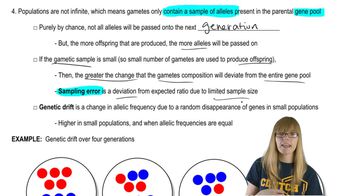
Genetic Drift

Mendelian Inheritance

Mendelian inheritance describes the patterns of inheritance for traits determined by single genes, as established by Gregor Mendel. In this scenario, the division of candies into male and female piles can be likened to the segregation of alleles during gamete formation. Understanding this concept helps in predicting the outcomes of genetic crosses and the likelihood of certain traits appearing in offspring.
Recommended video:
Guided course
05:13
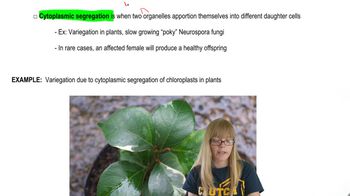
Organelle Inheritance

Random Sampling

Random sampling is a method used to select a subset of individuals from a larger population, ensuring that each individual has an equal chance of being chosen. In the context of this question, the act of drawing candies from the piles represents random sampling, which is essential for simulating genetic variation and understanding how traits may be expressed in a population. This concept is vital for conducting experiments and interpreting genetic data.
Recommended video:
Guided course
07:55
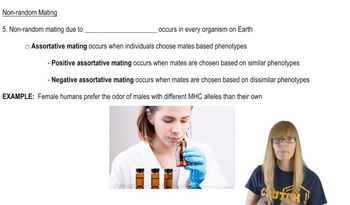
Non-Random Mating
Related Practice
Textbook Question

Put all the candies used in Problem 40 into a single mound and then divide them into four equal piles, this time being sure that the frequency of each color is the same in each pile. Label two of these piles 'male' and the other two 'female.' Half of the group will take one male and one female pile, and the other half of the group will take the other two piles. Each half of the group will carry out its own experiments: Determine the frequency of each candy color in the total of 25 draws (a total of 50 candies) and compare these frequencies with the original frequencies of the colors in the pile.

385
views
Textbook Question

Put all the candies used in Problem 40 into a single mound and then divide them into four equal piles, this time being sure that the frequency of each color is the same in each pile. Label two of these piles 'male' and the other two 'female.' Half of the group will take one male and one female pile, and the other half of the group will take the other two piles. Each half of the group will carry out its own experiments: Explain any observed differences in frequencies in terms of the evolutionary mechanism the results best emulate.

379
views
Textbook Question

Put all the candies used in Problems 41 back into a single mound and then divide them into two piles, being sure that the frequencies of each color are the same in each pile. Make a note of the starting frequency of each color. Label one pile 'male' and the other pile 'female.'

Have one person blindly draw one candy from the male pile and one candy from the female pile. Record the colors as though they were genotypes.

487
views
Textbook Question

Put all the candies used in Problems 41 back into a single mound and then divide them into two piles, being sure that the frequencies of each color are the same in each pile. Make a note of the starting frequency of each color. Label one pile 'male' and the other pile 'female.'

Repeat this process of blindly drawing one male and one female candy 12 to 15 times for each person in the group.

445
views
Textbook Question

Put all the candies used in Problems 41 back into a single mound and then divide them into two piles, being sure that the frequencies of each color are the same in each pile. Make a note of the starting frequency of each color. Label one pile 'male' and the other pile 'female.'

When all selection rounds have been completed, combine the two piles and determine the frequency of each color.

421
views
Textbook Question

Put all the candies used in Problems 41 back into a single mound and then divide them into two piles, being sure that the frequencies of each color are the same in each pile. Make a note of the starting frequency of each color. Label one pile 'male' and the other pile 'female.'

Compare the starting frequency of each color with the frequency after drawing. Describe the observed differences and identify the evolutionary mechanism this exercise best emulates.

433
views