Pearson+ LogoPearson+ Logo
Ch. 4 - Gene Interaction
Sanders - Genetic Analysis: An Integrated Approach 3rd Edition
Sanders3rd EditionGenetic Analysis: An Integrated ApproachISBN: 9780135564172Not the one you use?Change textbook
Chapter 4, Problem 20b

Brachydactyly type D is a human autosomal dominant condition in which the thumbs are abnormally short and broad. In most cases, both thumbs are affected, but occasionally just one thumb is involved. The accompanying pedigree shows a family in which brachydactyly type D is segregating. Filled circles and squares represent females and males who have involvement of both thumbs. Half-filled symbols represent family members with just one thumb affected.
Pedigree chart showing inheritance of brachydactyly type D in a family, indicating affected members.
Is there evidence of incomplete penetrance in this family? Explain. 

Verified step by step guidance
1
Examine the pedigree chart provided. Note that filled symbols represent individuals with both thumbs affected, and half-filled symbols represent individuals with one thumb affected. Open symbols represent unaffected individuals.
Identify the inheritance pattern of brachydactyly type D. Since the condition is autosomal dominant, affected individuals must have inherited at least one dominant allele from an affected parent.
Look for instances in the pedigree where an individual with an affected parent does not exhibit the condition (i.e., they are represented by an open symbol). This would suggest incomplete penetrance, where the dominant allele does not always result in the phenotype.
Consider the half-filled symbols in the pedigree. These represent individuals with only one thumb affected, which may also indicate variable expressivity of the dominant allele. Variable expressivity refers to differences in the severity or manifestation of a genetic condition among individuals with the same genotype.
Conclude whether there is evidence of incomplete penetrance. If there are unaffected individuals (open symbols) with affected parents, this supports incomplete penetrance. Additionally, the presence of half-filled symbols suggests variability in the expression of the condition.

Verified video answer for a similar problem:

This video solution was recommended by our tutors as helpful for the problem above.
Video duration:
4m
Was this helpful?

Key Concepts

Here are the essential concepts you must grasp in order to answer the question correctly.

Autosomal Dominant Inheritance

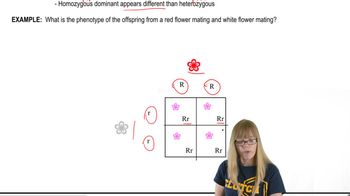
Autosomal dominant inheritance refers to a pattern where only one copy of a mutated gene from an affected parent can cause the condition in offspring. In the case of brachydactyly type D, the presence of the trait in successive generations indicates that the gene responsible is dominant, meaning affected individuals have a 50% chance of passing it on to their children.
Recommended video:
Guided course
04:37
Variations on Dominance

Incomplete Penetrance

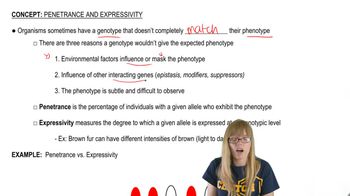
Incomplete penetrance occurs when not all individuals with a mutant genotype express the associated phenotype. In the context of the pedigree, if some individuals who inherit the brachydactyly gene do not exhibit the short and broad thumbs, this would be evidence of incomplete penetrance, suggesting that other factors may influence the expression of the trait.
Recommended video:
Guided course
02:09
Penetrance and Expressivity

Pedigree Analysis

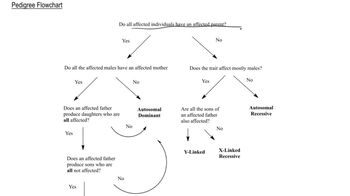
Pedigree analysis is a method used to track the inheritance of traits through generations in a family. By examining the pedigree chart, one can identify patterns of inheritance, such as whether a trait is dominant or recessive, and assess the presence of incomplete penetrance by observing affected and unaffected individuals across generations.
Recommended video:
Guided course
01:59
Pedigree Flowchart
Related Practice
Textbook Question

Feather color in parakeets is produced by the blending of pigments from two biosynthetic pathways shown below. Four independently assorting genes (A, B, C, and D) produce enzymes that catalyze separate steps of the pathways. For the questions below, use an uppercase letter to indicate a dominant allele producing full enzymatic activity and a lowercase letter to indicate a recessive allele producing no functional enzyme. Feather colors produced by mixing pigments are green (yellow + blue) and purple (red + blue). Red, yellow, and blue feathers result from production of one colored pigment, and white results from absence of pigment production.

If F₁ birds identified in part (c) are mated at random, what phenotypes do you expect in the F₂ generation? What are the ratios among phenotypes? Show your work. 

587
views
Textbook Question

Brachydactyly type D is a human autosomal dominant condition in which the thumbs are abnormally short and broad. In most cases, both thumbs are affected, but occasionally just one thumb is involved. The accompanying pedigree shows a family in which brachydactyly type D is segregating. Filled circles and squares represent females and males who have involvement of both thumbs. Half-filled symbols represent family members with just one thumb affected.

Is there any evidence of variable expressivity in this family? Explain. 

1058
views
Textbook Question

A male and a female mouse are each from pure-breeding albino strains. They have a litter of 10 pups, all of which have normal pigmentation. The F₁ pups are crossed to one another to produce 56 F₂ mice, of which 31 are normally pigmented and 25 are albino.

Using clearly defined allele symbols of your own choosing, give the genotypes of parental and F₁ mice. What genetic phenomenon explains these parental and F₁ phenotypes?

817
views
Textbook Question

A male and a female mouse are each from pure-breeding albino strains. They have a litter of 10 pups, all of which have normal pigmentation. The F₁ pups are crossed to one another to produce 56 F₂ mice, of which 31 are normally pigmented and 25 are albino.

What genetic phenomenon explains the F₂ results? Use your allelic symbols to explain the F₂ results.

508
views
Textbook Question

Xeroderma pigmentosum (XP) is an autosomal recessive condition characterized by moderate to severe sensitivity to ultraviolet (UV) light. Patients develop multiple skin lesions on UV-exposed skin, and skin cancers often develop as a result. XP is caused by deficient repair of DNA damage from UV exposure. Many genes are known to be involved in repair of UV-induced DNA damage, and several of these genes are implicated in XP. What genetic phenomenon is illustrated by XP?

546
views