Pearson+ LogoPearson+ Logo
Ch. 4 - Gene Interaction
Sanders - Genetic Analysis: An Integrated Approach 3rd Edition
Sanders3rd EditionGenetic Analysis: An Integrated ApproachISBN: 9780135564172Not the one you use?Change textbook
Chapter 4, Problem 21b

A male and a female mouse are each from pure-breeding albino strains. They have a litter of 10 pups, all of which have normal pigmentation. The F₁ pups are crossed to one another to produce 56 F₂ mice, of which 31 are normally pigmented and 25 are albino.
What genetic phenomenon explains the F₂ results? Use your allelic symbols to explain the F₂ results.

Verified step by step guidance
1
Identify the genetic phenomenon: The F₂ results suggest a classic Mendelian inheritance pattern involving a single gene with two alleles, where one allele is dominant (normal pigmentation) and the other is recessive (albino). This is consistent with a monohybrid cross.
Assign allelic symbols: Let 'A' represent the dominant allele for normal pigmentation and 'a' represent the recessive allele for albinism. The parental generation (P) consists of pure-breeding albino mice, so their genotypes are 'aa'.
Determine the F₁ generation: When the two pure-breeding albino mice (aa × aa) are crossed, the F₁ offspring all have normal pigmentation. This indicates that the albino strains are complementary, meaning the parents have mutations in different genes. The F₁ mice are heterozygous at both loci (AaBb).
Analyze the F₂ generation: The F₁ mice are crossed to produce the F₂ generation. A dihybrid cross (AaBb × AaBb) results in a phenotypic ratio of 9:7, where 9 individuals have normal pigmentation (at least one dominant allele at both loci) and 7 individuals are albino (homozygous recessive at either locus). This explains the observed F₂ results of 31 normal and 25 albino mice.
Summarize the genetic explanation: The F₂ results are explained by complementary gene action, where two genes interact to produce the pigmentation phenotype. Normal pigmentation requires at least one dominant allele at both loci (A-B-), while albinism occurs if either gene is homozygous recessive (aa-- or --bb).

Verified video answer for a similar problem:

This video solution was recommended by our tutors as helpful for the problem above.
Video duration:
5m
Was this helpful?

Key Concepts

Here are the essential concepts you must grasp in order to answer the question correctly.

Mendelian Inheritance

Mendelian inheritance refers to the principles of heredity established by Gregor Mendel, which include the concepts of dominant and recessive alleles. In this case, the albino trait is likely recessive, while normal pigmentation is dominant. This means that two pure-breeding albino mice (homozygous recessive) can produce offspring that express the dominant trait when crossed with a normal pigmented mouse carrying the dominant allele.
Recommended video:
Guided course
05:13
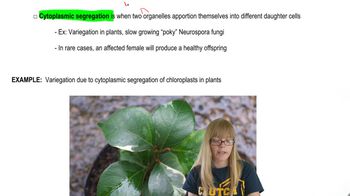
Organelle Inheritance

Genotype and Phenotype

The genotype is the genetic makeup of an organism, while the phenotype is the observable physical or biochemical characteristics. In this scenario, the F₁ generation consists of heterozygous individuals (Aa) for normal pigmentation, resulting from the cross of homozygous recessive (aa) albino mice. The F₂ generation's phenotypic ratio of 31 normally pigmented to 25 albino mice reflects the segregation of alleles during gamete formation.
Recommended video:
Guided course
07:52
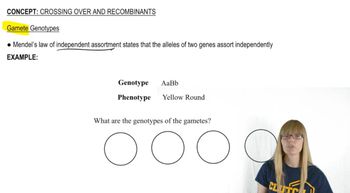
Gamete Genotypes

Punnett Square

A Punnett square is a diagram used to predict the genotypes of offspring from a genetic cross. In this case, crossing the F₁ generation (Aa x Aa) would yield a Punnett square showing the possible genotypes: 1 AA, 2 Aa, and 1 aa. This results in a phenotypic ratio of 3:1 for normal pigmentation to albino, which aligns with the observed F₂ results of 31 normally pigmented and 25 albino mice.
Recommended video:
Guided course
18:27
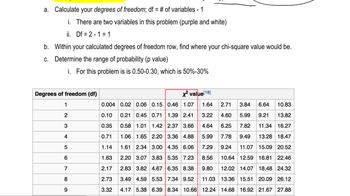
Chi Square Analysis
Related Practice
Textbook Question

Brachydactyly type D is a human autosomal dominant condition in which the thumbs are abnormally short and broad. In most cases, both thumbs are affected, but occasionally just one thumb is involved. The accompanying pedigree shows a family in which brachydactyly type D is segregating. Filled circles and squares represent females and males who have involvement of both thumbs. Half-filled symbols represent family members with just one thumb affected.

Is there any evidence of variable expressivity in this family? Explain. 

1058
views
Textbook Question

Brachydactyly type D is a human autosomal dominant condition in which the thumbs are abnormally short and broad. In most cases, both thumbs are affected, but occasionally just one thumb is involved. The accompanying pedigree shows a family in which brachydactyly type D is segregating. Filled circles and squares represent females and males who have involvement of both thumbs. Half-filled symbols represent family members with just one thumb affected.

Is there evidence of incomplete penetrance in this family? Explain. 

839
views
Textbook Question

A male and a female mouse are each from pure-breeding albino strains. They have a litter of 10 pups, all of which have normal pigmentation. The F₁ pups are crossed to one another to produce 56 F₂ mice, of which 31 are normally pigmented and 25 are albino.

Using clearly defined allele symbols of your own choosing, give the genotypes of parental and F₁ mice. What genetic phenomenon explains these parental and F₁ phenotypes?

817
views
Textbook Question

Xeroderma pigmentosum (XP) is an autosomal recessive condition characterized by moderate to severe sensitivity to ultraviolet (UV) light. Patients develop multiple skin lesions on UV-exposed skin, and skin cancers often develop as a result. XP is caused by deficient repair of DNA damage from UV exposure. Many genes are known to be involved in repair of UV-induced DNA damage, and several of these genes are implicated in XP. What genetic phenomenon is illustrated by XP?

546
views
Textbook Question

Xeroderma pigmentosum (XP) is an autosomal recessive condition characterized by moderate to severe sensitivity to ultraviolet (UV) light. Patients develop multiple skin lesions on UV-exposed skin, and skin cancers often develop as a result. XP is caused by deficient repair of DNA damage from UV exposure.


A series of 10 skin-cell lines was grown from different XP patients. Cells from these lines were fused, and the heterokaryons were tested for genetic complementation by assaying their ability to repair DNA damage caused by a moderate amount of UV exposure. In the table below, '+' indicates that the fusion cell line performs normal DNA damage mutation repair, and '−' indicates defective DNA repair. Use this information to determine how many DNA-repair genes are mutated in the 10 cell lines, and identify which cell lines share the same mutated genes. 

1054
views
Textbook Question

Three strains of green-seeded lentil plants appear to have the same phenotype. The strains are designated G₁, G₂, and G₃. Each green-seeded strain is crossed to a pure-breeding yellow-seeded strain designated Y. The F₁ of each cross are yellow; however, self-fertilization of F₁ plants produces F₂ with different proportions of yellow- and green-seeded plants as shown below.

For what number of genes are variable alleles segregating in the G₁ x Y cross? The G₂ x Y cross? In the G₃ x Y cross? Explain your rationale for each answer. 

691
views