Pearson+ LogoPearson+ Logo
Ch. 4 - Gene Interaction
Sanders - Genetic Analysis: An Integrated Approach 3rd Edition
Sanders3rd EditionGenetic Analysis: An Integrated ApproachISBN: 9780135564172Not the one you use?Change textbook
Chapter 4, Problem 11c

In the rats identified in Problem 10, a third independently assorting gene involved in the determination of coat color is the C gene. At this locus, the genotype C– permits expression of pigment from genes B and D. The cc genotype, however, prevents expression of coat color and results in albino rats. For each of the following crosses, determine the expected phenotype ratio of progeny.
bbDDCc×BBddCc

Verified step by step guidance
1
Identify the genotypes of the parents: The first parent is bbDDCc, and the second parent is BBddCc. Note that the C gene determines whether pigment is expressed, while the B and D genes determine the specific coat color if pigment is expressed.
Determine the possible gametes for each parent: For bbDDCc, the possible gametes are bDC and bDc. For BBddCc, the possible gametes are BdC and Bdc. This is because each gene segregates independently during gamete formation.
Set up a Punnett square for the C gene: Since both parents are heterozygous for the C gene (Cc), the offspring will have a 1:2:1 ratio for CC, Cc, and cc genotypes. Remember that cc results in albino rats, regardless of the B and D genes.
Analyze the B and D genes for the non-albino offspring (C–): For the B gene, the cross is bb × BB, which results in all offspring being heterozygous (Bb). For the D gene, the cross is DD × dd, which results in all offspring being heterozygous (Dd). Combine these results to determine the phenotype of the non-albino rats.
Combine the results: Use the ratios from the C gene (1:2:1 for CC, Cc, and cc) and the phenotypes determined by the B and D genes to calculate the overall phenotype ratio of the progeny. Remember to account for the fact that cc results in albino rats, which overrides any coat color determined by the B and D genes.

Verified video answer for a similar problem:

This video solution was recommended by our tutors as helpful for the problem above.
Video duration:
3m
Was this helpful?

Key Concepts

Here are the essential concepts you must grasp in order to answer the question correctly.

Independent Assortment

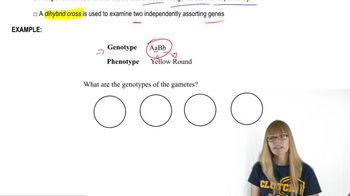
Independent assortment is a fundamental principle of genetics that states genes for different traits are inherited independently of one another. This means that the alleles of one gene segregate into gametes without affecting the segregation of alleles for another gene. In the context of the question, the C gene's independent assortment with the B and D genes allows for a variety of phenotypic combinations in the offspring.
Recommended video:
Guided course
04:58
Gamete Genetics and Independent Assortment

Genotype and Phenotype

Genotype refers to the genetic constitution of an organism, specifically the alleles present at a given locus. Phenotype, on the other hand, is the observable physical or biochemical characteristics of an organism, which result from the interaction of its genotype with the environment. In this question, understanding how the genotypes (C– and cc) influence the phenotypes (pigmented vs. albino) is crucial for predicting the offspring's traits.
Recommended video:
Guided course
07:52
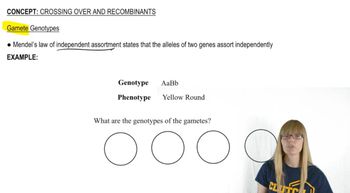
Gamete Genotypes

Punnett Square

A Punnett square is a diagram used to predict the genotypes of offspring from a genetic cross. It allows for the visualization of how alleles from each parent combine to form potential genotypes in the progeny. In this case, constructing a Punnett square for the cross bbDDCc × BBddCc will help determine the expected phenotype ratios by considering the contributions of each gene involved in coat color.
Recommended video:
Guided course
18:27
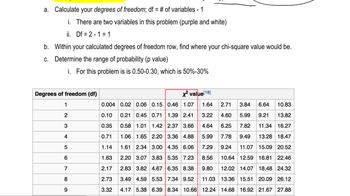
Chi Square Analysis
Related Practice
Textbook Question

In rats, gene B produces black coat color if the genotype is , but black pigment is not produced if the genotype is bb. At an independent locus, gene D produces yellow pigment if the genotype is D-, but no pigment is produced when the genotype is dd. Production of both pigments results in brown coat color. If neither pigment is produced, coat color is cream. Determine the genotypes of parents of litters with the following phenotype distributions.


9 black, 7 brown

548
views
Textbook Question

In the rats identified in Problem 10, a third independently assorting gene involved in the determination of coat color is the C gene. At this locus, the genotype C– permits expression of pigment from genes B and D. The cc genotype, however, prevents expression of coat color and results in albino rats. For each of the following crosses, determine the expected phenotype ratio of progeny.

BbDDCc×BbDdCc

384
views
Textbook Question

In the rats identified in Problem 10, a third independently assorting gene involved in the determination of coat color is the C gene. At this locus, the genotype C– permits expression of pigment from genes B and D. The cc genotype, however, prevents expression of coat color and results in albino rats. For each of the following crosses, determine the expected phenotype ratio of progeny.

BBDdcc×BbddCc

392
views
Textbook Question

In the rats identified in Problem 10, a third independently assorting gene involved in the determination of coat color is the C gene. At this locus, the genotype C– permits expression of pigment from genes B and D. The cc genotype, however, prevents expression of coat color and results in albino rats. For each of the following crosses, determine the expected phenotype ratio of progeny.

BbDdCC×BbDdCC

418
views
Textbook Question

Using the information provided in Problems 10 and 11, determine the genotype and phenotype of parents that produce the following progeny:

9/16 brown : 3/16 black : 4/16 albino

572
views
Textbook Question

Using the information provided in Problems 10 and 11, determine the genotype and phenotype of parents that produce the following progeny:

3/8 black : 3/8 cream : 2/8 albino

703
views