Pearson+ LogoPearson+ Logo
Ch. 6 - Genetic Analysis and Mapping in Bacteria and Bacteriophages
Sanders - Genetic Analysis: An Integrated Approach 3rd Edition
Sanders3rd EditionGenetic Analysis: An Integrated ApproachISBN: 9780135564172Not the one you use?Change textbook
Chapter 6, Problem 20a

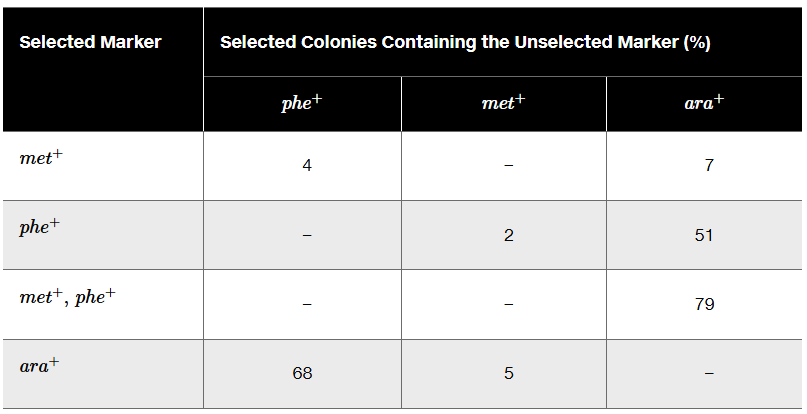
A triple-auxotrophic strain of E. coli having the genotype phe⁻ met⁻ ara⁻ is used as a recipient strain in a transduction experiment. The strain is unable to synthesize its own phenylalanine or methionine, and it carries a mutation that leaves it unable to utilize the sugar arabinose for growth. The recipient is crossed to a prototrophic strain with the genotype phe⁺ met⁺ ara⁺. The table below shows the selected marker and gives cotransduction frequencies for the unselected markers.
Table displaying cotransduction frequencies of selected and unselected markers in a transduction experiment with E. coli strains.
Identify the compounds present in each of the selective media.

Verified step by step guidance
1
Step 1: Understand the problem. The goal is to identify the compounds present in each selective media based on the genotype of the recipient strain (phe⁻ met⁻ ara⁻) and the donor strain (phe⁺ met⁺ ara⁺), as well as the cotransduction frequencies provided in the table.
Step 2: Recall the concept of selective media. Selective media are designed to allow the growth of organisms with specific genotypes while inhibiting others. For example, if a media lacks phenylalanine, only strains that can synthesize phenylalanine (phe⁺) will grow.
Step 3: Analyze the table. The table provides cotransduction frequencies for unselected markers when a specific marker is selected. For example, when phe⁺ is selected, 2% of colonies contain met⁺ and 51% contain ara⁺. This information helps determine which markers are linked and which compounds are required for growth.
Step 4: Determine the compounds in the selective media for each marker. For phe⁺ selection, the media likely lacks phenylalanine, forcing only phe⁺ strains to grow. For met⁺ selection, the media likely lacks methionine, allowing only met⁺ strains to grow. For ara⁺ selection, the media likely contains arabinose as the sole sugar source, allowing only ara⁺ strains to utilize it for growth.
Step 5: Use the cotransduction frequencies to infer genetic linkage. Higher cotransduction frequencies indicate closer genetic linkage between markers. For example, the high cotransduction frequency (79%) between met⁺ and phe⁺ suggests these genes are closely linked, which can help interpret the results of the experiment and the compounds required in the media.

Verified video answer for a similar problem:

This video solution was recommended by our tutors as helpful for the problem above.
Video duration:
1m
Was this helpful?

Key Concepts

Here are the essential concepts you must grasp in order to answer the question correctly.

Auxotrophy and Prototrophy

Auxotrophy refers to the inability of an organism to synthesize a particular compound required for its growth, necessitating supplementation from the environment. In contrast, prototrophic organisms can synthesize all necessary compounds from basic nutrients. In this experiment, the E. coli strain is auxotrophic for phenylalanine (phe⁻) and methionine (met⁻), while the prototrophic strain can grow without additional supplements.
Recommended video:
Guided course
09:35
Bacteria in the Laboratory

Transduction

Transduction is a process of horizontal gene transfer in bacteria, where bacteriophages (viruses that infect bacteria) transfer genetic material from one bacterium to another. This method can introduce new traits, such as the ability to synthesize certain compounds, into the recipient strain. Understanding transduction is crucial for interpreting the genetic changes observed in the E. coli strains during the experiment.
Recommended video:

Cotransduction Frequencies

Cotransduction frequencies indicate the likelihood that two genetic markers are transferred together during transduction. High cotransduction frequencies suggest that the markers are located close to each other on the bacterial chromosome, while low frequencies imply they are farther apart. Analyzing these frequencies helps determine the genetic linkage and the effectiveness of the transduction process in the experiment.
Recommended video:
Related Practice
Textbook Question

An Hfr strain with the genotype cys⁺ lue⁺ met⁺ strS is mated with an F- strain carrying the genotype cys⁻ lue⁻ met⁻ strᴿ. In an interrupted mating experiment, small samples of the conjugating bacteria are withdrawn every 3 minutes for 30 minutes. The withdrawn cells are shaken vigorously to stop conjugation and then placed on three different selection media, composed as follows:


Medium 1: Minimal medium plus leucine, methionine, and streptomycin

Medium 2: Minimal medium plus cysteine, methionine, and streptomycin

Medium 3: Minimal medium plus cysteine, leucine, and streptomycin


What is the purpose of adding streptomycin to each selection medium?

718
views
Textbook Question

An Hfr strain with the genotype cys⁺ lue⁺ met⁺ strˢ is mated with an F- strain carrying the genotype cys⁻ lue⁻ met⁻ strᴿ. In an interrupted mating experiment, small samples of the conjugating bacteria are withdrawn every 3 minutes for 30 minutes. The withdrawn cells are shaken vigorously to stop conjugation and then placed on three different selection media, composed as follows:


Medium 1: Minimal medium plus leucine, methionine, and streptomycin

Medium 2: Minimal medium plus cysteine, methionine, and streptomycin

Medium 3: Minimal medium plus cysteine, leucine, and streptomycin


The following table shows the number of colonies growing on each selection medium. The sampling time indicates how many minutes have passed since conjugation began.


Sampling Time (minutes)       Number of Colonies

                      Plate 1    Plate 2    Plate 3

      3                 0         0         0

      6                0         0         0

      9                 0        62         0

     12                 0        87         0

     15                 51       124        0

     18                 79       210        62

     21                109       250        85

     24                144       250       111

     27                152       250       122

     30                152       250       122


Determine the order of donor genes cys, leu, and met from the interrupted mating data.

694
views
Textbook Question

A triple-auxotrophic strain of E. coli having the genotype phe⁻ met⁻ ara⁻ is used as a recipient strain in a transduction experiment. The strain is unable to synthesize its own phenylalanine or methionine, and it carries a mutation that leaves it unable to utilize the sugar arabinose for growth. The recipient is crossed to a prototrophic strain with the genotype phe⁺ met⁺ ara⁺. The table below shows the selected marker and gives cotransduction frequencies for the unselected markers.

Use the cotransduction data to determine the order of these genes.

463
views
Textbook Question

Penicillin was first used in the 1940s to treat gonorrhea infections produced by the bacterium Neisseria gonorrhoeae. In 1984, according to the CDC, fewer than 1% of gonorrhea infections were caused by penicillin-resistant N. gonorrhoeae. By 1990, more than 10% of cases were penicillin-resistant, and a few years later the level of resistance was at greater than 95%. Almost every year the CDC issues new treatment guidelines for gonorrhea that identify the recommended antibiotic drugs and dosages.

Why is the CDC so active in making these recommendations?

668
views
Textbook Question

Penicillin was first used in the 1940s to treat gonorrhea infections produced by the bacterium Neisseria gonorrhoeae. In 1984, according to the CDC, fewer than 1% of gonorrhea infections were caused by penicillin-resistant N. gonorrhoeae. By 1990, more than 10% of cases were penicillin-resistant, and a few years later the level of resistance was at greater than 95%. Almost every year the CDC issues new treatment guidelines for gonorrhea that identify the recommended antibiotic drugs and dosages.

What are the short-term implications of these frequent changes for physicians and clinics that treat sexually transmitted diseases like gonorrhea and for individuals infected with gonorrhea?

575
views
Textbook Question

Penicillin was first used in the 1940s to treat gonorrhea infections produced by the bacterium Neisseria gonorrhoeae. In 1984, according to the CDC, fewer than 1% of gonorrhea infections were caused by penicillin-resistant N. gonorrhoeae. By 1990, more than 10% of cases were penicillin-resistant, and a few years later the level of resistance was at greater than 95%. Almost every year the CDC issues new treatment guidelines for gonorrhea that identify the recommended antibiotic drugs and dosages.

What are the long-term implications of these frequent changes in treatment recommendations for the patient population?

537
views