
Suppose that future exploration of polar ice on Mars identifies a living microbe and that analysis indicates the organism carries double-stranded DNA as its genetic material. Suppose further that DNA replication analysis is performed by first growing the microbe in a growth medium containing the heavy isotope of nitrogen (¹⁴N) that the organism is then transferred to a growth medium containing the light isotope of nitrogen (¹⁴N) and that the nitrogen composition of the DNA is examined by CsCl ultracentrifugation and densitometry after the first, second, and third replication cycles in the ¹⁴N-containing medium. The results of the experiment are illustrated here for each cycle. The control shows the positioning of the three possible DNA densities. Based on the results shown, what can you conclude about the mechanism of DNA replication in this organism?

- Ch. 1 - The Molecular Basis of Heredity, Variation, and Evolution64
- Ch. 2 - Transmission Genetics144
- Ch. 3 - Cell Division and Chromosome Heredity81
- Ch. 4 - Gene Interaction87
- Ch. 5 - Genetic Linkage and Mapping in Eukaryotes103
- Ch. 6 - Genetic Analysis and Mapping in Bacteria and Bacteriophages73
- Ch. 7 - DNA Structure and Replication71
- Ch. 8 - Molecular Biology of Transcription and RNA Processing79
- Ch. 9 - The Molecular Biology of Translation110
- Ch. 10 - Eukaryotic Chromosome Abnormalities and Molecular Organization100
- Ch. 11 - Gene Mutation, DNA Repair, and Homologous Recombination86
- Ch. 12 - Regulation of Gene Expression in Bacteria and Bacteriophage90
- Ch. 13 - Regulation of Gene Expression in Eukaryotes38
- Ch. 14 - Analysis of Gene Function via Forward Genetics and Reverse Genetics72
- Ch. 15 - Recombinant DNA Technology and Its Applications69
- Ch. 16 - Genomics: Genetics from a Whole-Genome Perspective49
- Ch. 17 - Organelle Inheritance and the Evolution of Organelle Genomes27
- Ch. 18 - Developmental Genetics43
- Ch. 19 - Genetic Analysis of Quantitative Traits66
- Ch. 20 - Population Genetics and Evolution at the Population, Species, and Molecular Levels105
Go to the OMIM website (https://www.ncbi.nlm.nih.gov/omim) and type 'dyskeratosis congenita autosomal dominant 1' (DKCA1) into the search bar. The result will include a clickable link to the disorder that has an OMIM number of 127550. Review the OMIM information you retrieve and notice that this disorder is caused by a mutation of a telomerase gene that results in abnormally rapid shortening of telomeres and the appearance of disease symptoms at progressively younger ages in successive generations of the affected families. Use this and other information on OMIM to assist with this problem. Go to reference number 15 at the bottom of the OMIM page for a link to a 2004 paper by Tom Vulliamy and colleagues that appeared in the journal Nature Genetics. Click on the 'Full text' option and download a copy of the paper. Look at Table 1 of the paper on page 448. This table lists the lengths of telomeres measured in members of the families in this study. Telomeres shorten with age, and the telomere lengths in Table 1 are age-adjusted. The negative numbers for telomere lengths in the table indicate that telomeres are shorter than average for age, and the more negative the number, the shorter the telomere. Based on Table 1, the the discussion in the Vulliamy et al. (2004) paper, and information available on OMIM, answer the following:
Why are telomeres of people with DKCA1 shorter than average?
 Verified step by step guidance
Verified video answer for a similar problem:

Key Concepts
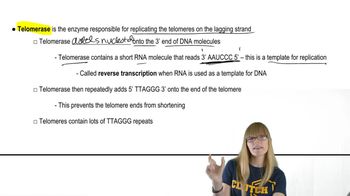
Telomeres
 08:38
08:38
Telomerase
08:38Genetic Inheritance
 27:36
27:36The following diagram shows the parental strands of a DNA molecule undergoing replication.
Draw the daughter strands present in the replication bubble, indicating:
a. The polarity of daughter strands
b. The leading and lagging strands
c. Okazaki fragments
d. The locations of RNA primers
Go to the OMIM website (https://www.ncbi.nlm.nih.gov/omim) and type 'dyskeratosis congenita autosomal dominant 1' (DKCA1) into the search bar. The result will include a clickable link to the disorder that has an OMIM number of 127550. Review the OMIM information you retrieve and notice that this disorder is caused by a mutation of a telomerase gene that results in abnormally rapid shortening of telomeres and the appearance of disease symptoms at progressively younger ages in successive generations of the affected families. Use this and other information on OMIM to assist with this problem. Go to reference number 15 at the bottom of the OMIM page for a link to a 2004 paper by Tom Vulliamy and colleagues that appeared in the journal Nature Genetics. Click on the 'Full text' option and download a copy of the paper. Look at Table 1 of the paper on page 448. This table lists the lengths of telomeres measured in members of the families in this study. Telomeres shorten with age, and the telomere lengths in Table 1 are age-adjusted. The negative numbers for telomere lengths in the table indicate that telomeres are shorter than average for age, and the more negative the number, the shorter the telomere. Based on Table 1, the discussion in the Vulliamy et al. (2004) paper, and information available on OMIM, answer the following:
How do telomere lengths in children compare with telomere lengths of their parents?