Pearson+ LogoPearson+ Logo
Ch. 7 - DNA Structure and Replication
Sanders - Genetic Analysis: An Integrated Approach 3rd Edition
Sanders3rd EditionGenetic Analysis: An Integrated ApproachISBN: 9780135564172Not the one you use?Change textbook
Chapter 7, Problem 1

What results from the experiments of Frederick Griffith provided the strongest support for his conclusion that a transformation factor is responsible for heredity?

Verified step by step guidance
1
Understand the context of Frederick Griffith's experiments: Griffith was studying two strains of the bacterium *Streptococcus pneumoniae*—a smooth (S) strain, which is virulent, and a rough (R) strain, which is non-virulent.
Recall the key experimental setup: Griffith injected mice with different combinations of these bacterial strains, including live R strain, live S strain, heat-killed S strain, and a mixture of live R strain with heat-killed S strain.
Focus on the critical observation: Mice injected with the mixture of live R strain and heat-killed S strain developed pneumonia and died, and live S strain bacteria were recovered from their bodies.
Interpret the results: The transformation of the non-virulent R strain into the virulent S strain suggested that some 'transforming factor' from the heat-killed S strain was transferred to the R strain, enabling it to acquire the virulent properties.
Conclude the significance: This experiment provided strong evidence that the 'transforming factor' was responsible for heredity, laying the groundwork for identifying DNA as the genetic material in later experiments.

Verified video answer for a similar problem:

This video solution was recommended by our tutors as helpful for the problem above.
Video duration:
5m
Was this helpful?

Key Concepts

Here are the essential concepts you must grasp in order to answer the question correctly.

Griffith's Experiment

Frederick Griffith conducted experiments in 1928 using two strains of Streptococcus pneumoniae: a virulent strain with a smooth appearance and a non-virulent strain with a rough appearance. He discovered that when he injected mice with heat-killed virulent bacteria mixed with live non-virulent bacteria, the mice developed pneumonia and died. This indicated that some 'transforming principle' from the dead bacteria was taken up by the live bacteria, transforming them into a virulent form.
Recommended video:
Guided course
08:06
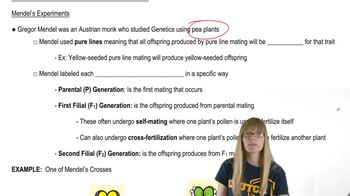
Mendel's Experiments

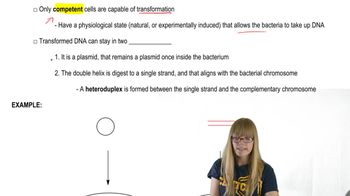
Transformation

Transformation is a process in which a bacterium takes up foreign DNA from its environment and incorporates it into its own genome. In Griffith's experiment, the non-virulent bacteria acquired the genetic material from the heat-killed virulent bacteria, leading to a change in phenotype. This concept is fundamental in genetics as it demonstrates how genetic information can be transferred between organisms, influencing traits and characteristics.
Recommended video:
Guided course
05:48
Transformation

Avery-MacLeod-McCarty Experiment

Building on Griffith's findings, the Avery-MacLeod-McCarty experiment in 1944 identified DNA as the 'transforming factor.' By treating the heat-killed virulent bacteria with enzymes that destroyed proteins, RNA, or DNA, they showed that only the destruction of DNA prevented transformation in the non-virulent bacteria. This provided strong evidence that DNA is the molecule responsible for heredity, supporting Griffith's initial conclusions about the transformation factor.
Recommended video:
Guided course
08:06
Mendel's Experiments