Pearson+ LogoPearson+ Logo
Ch. 7 - DNA Structure and Replication
Sanders - Genetic Analysis: An Integrated Approach 3rd Edition
Sanders3rd EditionGenetic Analysis: An Integrated ApproachISBN: 9780135564172Not the one you use?Change textbook
Chapter 7, Problem 36

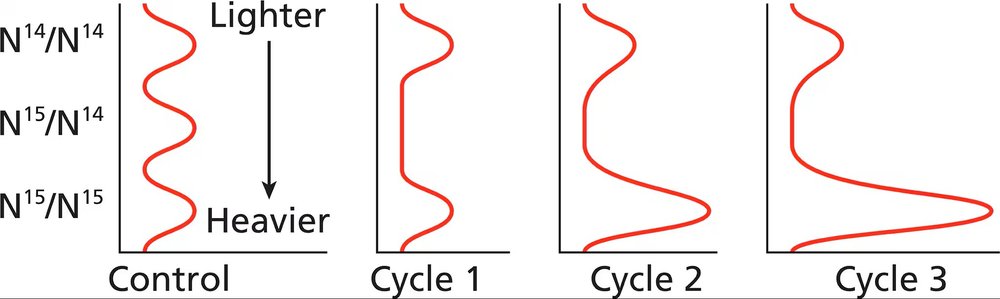
Suppose that future exploration of polar ice on Mars identifies a living microbe and that analysis indicates the organism carries double-stranded DNA as its genetic material. Suppose further that DNA replication analysis is performed by first growing the microbe in a growth medium containing the heavy isotope of nitrogen (¹⁴N) that the organism is then transferred to a growth medium containing the light isotope of nitrogen (¹⁴N) and that the nitrogen composition of the DNA is examined by CsCl ultracentrifugation and densitometry after the first, second, and third replication cycles in the ¹⁴N-containing medium. The results of the experiment are illustrated here for each cycle. The control shows the positioning of the three possible DNA densities. Based on the results shown, what can you conclude about the mechanism of DNA replication in this organism?
Graph showing DNA density results from nitrogen isotope experiments across three replication cycles, with control for comparison.

Verified step by step guidance
1
Step 1: Begin by understanding the Meselson and Stahl experiment, which demonstrated the semi-conservative mechanism of DNA replication in E. coli. In semi-conservative replication, each new DNA molecule consists of one original (parental) strand and one newly synthesized strand. This experiment used isotopes of nitrogen (¹⁵N and ¹⁴N) to distinguish between old and new DNA strands based on their density.
Step 2: Analyze the experimental setup described in the problem. The microbe is first grown in a medium containing the heavy isotope of nitrogen (¹⁵N), which incorporates into its DNA, making it denser. Then, the organism is transferred to a medium containing the light isotope of nitrogen (¹⁴N), and DNA replication occurs in this new medium. The density of the DNA is examined after each replication cycle using CsCl ultracentrifugation and densitometry.
Step 3: Interpret the results of the first replication cycle. If the DNA replication is semi-conservative, the DNA molecules will consist of one strand with ¹⁵N (heavy) and one strand with ¹⁴N (light). This hybrid DNA will have an intermediate density between the heavy and light DNA controls.
Step 4: Examine the results of the second replication cycle. In semi-conservative replication, each hybrid DNA molecule will produce two new DNA molecules: one hybrid (intermediate density) and one fully light DNA molecule (light density). This will result in two distinct bands in the densitometry analysis: one at intermediate density and one at light density.
Step 5: Analyze the results of the third replication cycle. With each subsequent cycle, the proportion of fully light DNA molecules increases, while the proportion of hybrid DNA molecules decreases. By the third cycle, the densitometry analysis should show a stronger band at the light density and a weaker band at the intermediate density. This pattern confirms the semi-conservative mechanism of DNA replication in the organism.

Verified video answer for a similar problem:

This video solution was recommended by our tutors as helpful for the problem above.
Video duration:
5m
Was this helpful?

Key Concepts

Here are the essential concepts you must grasp in order to answer the question correctly.

DNA Replication Mechanisms

DNA replication can occur through three primary mechanisms: conservative, semi-conservative, and dispersive. In conservative replication, the original DNA molecule remains intact, while a completely new copy is made. Semi-conservative replication, which is the mechanism confirmed by the Meselson and Stahl experiment, involves each new DNA molecule consisting of one original strand and one newly synthesized strand. Dispersive replication results in DNA strands that are mixtures of old and new DNA.
Recommended video:
Guided course
11:59
Steps to DNA Replication

Meselson and Stahl Experiment

The Meselson and Stahl experiment was a pivotal study that demonstrated the semi-conservative nature of DNA replication. By using isotopes of nitrogen (¹⁵N and ¹⁴N), they were able to track the distribution of DNA strands after several replication cycles. The results showed that after one replication cycle, all DNA had an intermediate density, and after two cycles, there were distinct bands corresponding to both light and hybrid DNA, confirming that each new DNA molecule contained one old and one new strand.
Recommended video:
Guided course
08:06
Mendel's Experiments

CsCl Ultracentrifugation

CsCl ultracentrifugation is a technique used to separate DNA based on its density. When DNA is subjected to a high-speed centrifugation in a cesium chloride gradient, the DNA molecules will settle at a position corresponding to their density. This method was crucial in the Meselson and Stahl experiment, as it allowed the researchers to visualize the different densities of DNA after replication, providing clear evidence for the semi-conservative model of DNA replication.
Related Practice
Textbook Question

You are participating in a study group preparing for an upcoming genetics exam, and one member of the group proposes that each of you draw the structure of two DNA nucleotides joined in a single strand. The figures are drawn and exchanged for correction. You receive the accompanying diagram to correct: Identify and correct at least five things that are wrong in the depiction of each nucleotide.

391
views
Textbook Question

You are participating in a study group preparing for an upcoming genetics exam, and one member of the group proposes that each of you draw the structure of two DNA nucleotides joined in a single strand. The figures are drawn and exchanged for correction. You receive the accompanying diagram to correct: What is wrong with the way the nucleotides are joined?

385
views
Textbook Question

You are participating in a study group preparing for an upcoming genetics exam, and one member of the group proposes that each of you draw the structure of two DNA nucleotides joined in a single strand. The figures are drawn and exchanged for correction. You receive the accompanying diagram to correct: Draw this single-stranded segment correctly.

372
views
Textbook Question

The following diagram shows the parental strands of a DNA molecule undergoing replication.

Draw the daughter strands present in the replication bubble, indicating:

a. The polarity of daughter strands

b. The leading and lagging strands

c. Okazaki fragments

d. The locations of RNA primers

835
views
Textbook Question

Go to the OMIM website (https://www.ncbi.nlm.nih.gov/omim) and type 'dyskeratosis congenita autosomal dominant 1' (DKCA1) into the search bar. The result will include a clickable link to the disorder that has an OMIM number of 127550. Review the OMIM information you retrieve and notice that this disorder is caused by a mutation of a telomerase gene that results in abnormally rapid shortening of telomeres and the appearance of disease symptoms at progressively younger ages in successive generations of the affected families. Use this and other information on OMIM to assist with this problem. Go to reference number 15 at the bottom of the OMIM page for a link to a 2004 paper by Tom Vulliamy and colleagues that appeared in the journal Nature Genetics. Click on the 'Full text' option and download a copy of the paper. Look at Table 1 of the paper on page 448. This table lists the lengths of telomeres measured in members of the families in this study. Telomeres shorten with age, and the telomere lengths in Table 1 are age-adjusted. The negative numbers for telomere lengths in the table indicate that telomeres are shorter than average for age, and the more negative the number, the shorter the telomere. Based on Table 1, the discussion in the Vulliamy et al. (2004) paper, and information available on OMIM, answer the following:

How do telomere lengths in children compare with telomere lengths of their parents?

453
views
Textbook Question

Go to the OMIM website (https://www.ncbi.nlm.nih.gov/omim) and type 'dyskeratosis congenita autosomal dominant 1' (DKCA1) into the search bar. The result will include a clickable link to the disorder that has an OMIM number of 127550. Review the OMIM information you retrieve and notice that this disorder is caused by a mutation of a telomerase gene that results in abnormally rapid shortening of telomeres and the appearance of disease symptoms at progressively younger ages in successive generations of the affected families. Use this and other information on OMIM to assist with this problem. Go to reference number 15 at the bottom of the OMIM page for a link to a 2004 paper by Tom Vulliamy and colleagues that appeared in the journal Nature Genetics. Click on the 'Full text' option and download a copy of the paper. Look at Table 1 of the paper on page 448. This table lists the lengths of telomeres measured in members of the families in this study. Telomeres shorten with age, and the telomere lengths in Table 1 are age-adjusted. The negative numbers for telomere lengths in the table indicate that telomeres are shorter than average for age, and the more negative the number, the shorter the telomere. Based on Table 1, the the discussion in the Vulliamy et al. (2004) paper, and information available on OMIM, answer the following:

Why are telomeres of people with DKCA1 shorter than average?

419
views