Pearson+ LogoPearson+ Logo
Ch. 8 - Molecular Biology of Transcription and RNA Processing
Sanders - Genetic Analysis: An Integrated Approach 3rd Edition
Sanders3rd EditionGenetic Analysis: An Integrated ApproachISBN: 9780135564172Not the one you use?Change textbook
Chapter 8, Problem 20d

Wild-type E. coli grows best at 37°C but can grow efficiently up to 42°C. An E. coli strain has a mutation of the sigma subunit that results in an RNA polymerase holoenzyme that is stable and transcribes at wild-type levels at 37°C. The mutant holoenzyme is progressively destabilized as the temperature is raised, and it completely denatures and ceases to carry out transcription at 42°C. Relative to wild-type growth, characterize the ability of the mutant strain to carry out transcription at What term best characterizes the type of mutation exhibited by the mutant bacterial strain? (Hint: The term was used in Chapter 4 to describe the Himalayan allele of the mammalian C gene.)

Verified step by step guidance
1
Step 1: Begin by understanding the problem. The question describes a mutation in the sigma subunit of RNA polymerase in E. coli. This mutation affects the stability of the holoenzyme at higher temperatures, leading to its denaturation and cessation of transcription at 42°C. The goal is to characterize the type of mutation based on its temperature-dependent behavior.
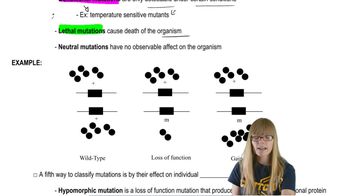
Step 2: Recall the concept of temperature-sensitive mutations. These mutations result in proteins that function normally at a permissive temperature (e.g., 37°C) but lose functionality at a restrictive temperature (e.g., 42°C). This is a key clue to identifying the mutation type.
Step 3: Relate this to the hint provided in the problem. The hint references the Himalayan allele of the mammalian C gene, which is a classic example of a temperature-sensitive mutation. In Himalayan rabbits, the C gene is functional at cooler temperatures (e.g., extremities of the body) but nonfunctional at warmer temperatures (e.g., the body core).
Step 4: Apply this concept to the mutant E. coli strain. The mutant RNA polymerase holoenzyme is stable and functional at 37°C (permissive temperature) but becomes destabilized and nonfunctional at 42°C (restrictive temperature). This temperature-dependent behavior aligns with the definition of a temperature-sensitive mutation.
Step 5: Conclude that the term best characterizing the mutation in the mutant bacterial strain is 'temperature-sensitive mutation,' as it describes the loss of function at higher, restrictive temperatures while maintaining normal function at lower, permissive temperatures.

Verified video answer for a similar problem:

This video solution was recommended by our tutors as helpful for the problem above.
Video duration:
3m
Was this helpful?

Key Concepts

Here are the essential concepts you must grasp in order to answer the question correctly.

Temperature Sensitivity

Temperature sensitivity refers to the dependence of an organism's biological processes on temperature. In the context of E. coli, this concept highlights how the stability and functionality of proteins, such as RNA polymerase, can be affected by temperature changes. A temperature-sensitive mutation may result in a protein that functions normally at lower temperatures but becomes unstable or inactive at higher temperatures.
Recommended video:
Guided course
10:48
Mutations and Phenotypes

Sigma Factor and RNA Polymerase

The sigma factor is a protein that associates with RNA polymerase to facilitate the initiation of transcription in bacteria. It helps the RNA polymerase holoenzyme recognize specific promoter regions on DNA. Mutations in the sigma factor can lead to changes in the stability and activity of the RNA polymerase, impacting the transcription process, especially under varying environmental conditions like temperature.
Recommended video:

Conditional Mutation

A conditional mutation is a genetic alteration that results in a phenotype that is only expressed under certain environmental conditions, such as temperature. In this case, the E. coli strain exhibits normal transcription at 37°C but fails to do so at 42°C due to the destabilization of the RNA polymerase holoenzyme. This type of mutation is crucial for understanding how organisms adapt to different environments and can be linked to specific alleles, such as the Himalayan allele mentioned in the question.
Recommended video:
Guided course
10:48
Mutations and Phenotypes
Related Practice
Textbook Question

Wild-type E. coli grow best at 37°C but can grow efficiently up to 42°C. An E. coli strain has a mutation of the sigma subunit that results in an RNA polymerase holoenzyme that is stable and transcribes at wild-type levels at 37°C. The mutant holoenzyme is progressively destabilized as the temperature is raised, and it completely denatures and ceases to carry out transcription at 42°C. Relative to wild-type growth, characterize the ability of the mutant strain to carry out transcription at 37°C

481
views
Textbook Question

Wild-type E. coli grows best at 37°C but can grow efficiently up to 42°C. An E. coli strain has a mutation of the sigma subunit that results in an RNA polymerase holoenzyme that is stable and transcribes at wild-type levels at 37°C. The mutant holoenzyme is progressively destabilized as the temperature is raised, and it completely denatures and ceases to carry out transcription at 42°C. Relative to wild-type growth, characterize the ability of the mutant strain to carry out transcription at 40°C

866
views
Textbook Question

Wild-type E. coli grows best at 37°C but can grow efficiently up to 42°C. An E. coli strain has a mutation of the sigma subunit that results in an RNA polymerase holoenzyme that is stable and transcribes at wild-type levels at 37°C. The mutant holoenzyme is progressively destabilized as the temperature is raised, and it completely denatures and ceases to carry out transcription at 42°C. Relative to wild-type growth, characterize the ability of the mutant strain to carry out transcription at 42°C

550
views
Textbook Question

A mutant strain of Salmonella bacteria carries a mutation of the rho protein that has full activity at 37°C but is completely inactivated when the mutant strain is grown at 40°C. Speculate about the kind of differences you would expect to see if you compared a broad spectrum of mRNAs from the mutant strain grown at 37°C and the same spectrum of mRNAs from the strain when grown at 40°C.

551
views
Textbook Question

A mutant strain of Salmonella bacteria carries a mutation of the rho protein that has full activity at 37°C but is completely inactivated when the mutant strain is grown at 40°C. Are all mRNAs affected by the rho protein mutation in the same way? Why or why not?

503
views
Textbook Question

The human β-globin wild-type allele and a certain mutant allele are identical in sequence except for a single base-pair substitution that changes one nucleotide at the end of intron 2. The wild-type and mutant sequences of the affected portion of pre-mRNA are

Speculate about the way in which this base substitution causes mutation of β-globin protein.

500
views