Pearson+ LogoPearson+ Logo
Ch. 9 - The Molecular Biology of Translation
Sanders - Genetic Analysis: An Integrated Approach 3rd Edition
Sanders3rd EditionGenetic Analysis: An Integrated ApproachISBN: 9780135564172Not the one you use?Change textbook
Chapter 9, Problem B.1a

Answer the following questions for autosomal conditions such as PKU.
If both parents are heterozygous carriers of a mutant allele, what is the chance that their first child will be homozygous recessive for the mutation?

Verified step by step guidance
1
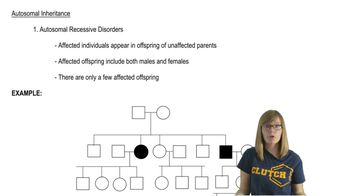
Identify the inheritance pattern: Since the condition is autosomal recessive, the disease manifests only when an individual has two copies of the mutant allele (homozygous recessive).
Define the genotypes of the parents: Both parents are heterozygous carriers, meaning their genotype is Aa, where A is the normal allele and a is the mutant allele.
Set up a Punnett square to determine the possible genotypes of their offspring by combining the alleles from each parent: the possible combinations are AA, Aa, aA, and aa.
Calculate the probability of the child being homozygous recessive (aa): count the number of aa outcomes over the total possible outcomes in the Punnett square.
Express the probability as a fraction or percentage to represent the chance that the first child will be homozygous recessive for the mutation.

Verified video answer for a similar problem:

This video solution was recommended by our tutors as helpful for the problem above.
Video duration:
1m
Was this helpful?

Key Concepts

Here are the essential concepts you must grasp in order to answer the question correctly.

Autosomal Recessive Inheritance

Autosomal recessive inheritance occurs when a trait or disorder is expressed only if an individual inherits two copies of a mutant allele, one from each parent. Carriers have one normal and one mutant allele but typically do not show symptoms. Diseases like PKU follow this pattern.
Recommended video:
Guided course
09:08
Autosomal Pedigrees

Genotype Probability in Offspring

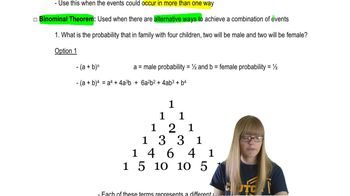
When both parents are heterozygous carriers (Aa), the possible genotypes for their child are AA, Aa, or aa. Using a Punnett square, the probability of the child being homozygous recessive (aa) is 25%, as each allele is inherited independently.
Recommended video:

Phenotypic Expression of Homozygous Recessive

Individuals who are homozygous recessive (aa) for a mutation typically express the autosomal recessive condition, such as PKU. This means the disease phenotype manifests only when both alleles are mutant, highlighting the importance of genotype in predicting disease risk.
Recommended video:
Guided course
02:09
Penetrance and Expressivity
Related Practice
Textbook Question

Describe the gene and protein defects in phenylketonuria (PKU). How are these defects connected to disease symptoms?

430
views
Textbook Question

Answer the following questions for autosomal conditions such as PKU.

Parents who are each heterozygous carriers for a recessive mutant allele have a child who does not have the condition. What is the chance this child is a heterozygous carrier of the condition?

426
views
Textbook Question

Answer the following questions for autosomal conditions such as PKU.

If the first child of parents who are both heterozygous carriers of a recessive mutant allele is homozygous recessive, what is the chance the second child of the couple will be homozygous recessive? What is the chance the second child will be a heterozygous carrier of the recessive mutation?

403
views
Textbook Question

Homocystinuria is a rare autosomal recessive condition on the RUSP list of conditions screened by newborn genetic testing. The condition results from a mutation that blocks the degradation of the amino acid methionine. The absence of a critical enzyme causes the buildup of the compound homocysteine, which is one of the intermediate compounds in the methionine breakdown pathway. Homocystinuria causes mental impairment, heart problems, seizures, eye abnormalities, and a number of other symptoms that shorten life if not treated. The condition is treated by a specialized diet that is low in methionine and by the ingestion of several supplements.

Why do you think eating a low-methionine diet is critical to controlling homocystinuria?

714
views