Answer the following questions for autosomal conditions such as PKU.
If both parents are heterozygous carriers of a mutant allele, what is the chance that their first child will be homozygous recessive for the mutation?

Verified step by step guidance
Answer the following questions for autosomal conditions such as PKU.
If both parents are heterozygous carriers of a mutant allele, what is the chance that their first child will be homozygous recessive for the mutation?
Answer the following questions for autosomal conditions such as PKU.
Parents who are each heterozygous carriers for a recessive mutant allele have a child who does not have the condition. What is the chance this child is a heterozygous carrier of the condition?
Answer the following questions for autosomal conditions such as PKU.
If the first child of parents who are both heterozygous carriers of a recessive mutant allele is homozygous recessive, what is the chance the second child of the couple will be homozygous recessive? What is the chance the second child will be a heterozygous carrier of the recessive mutation?
Homocystinuria is a rare autosomal recessive condition on the RUSP list of conditions screened by newborn genetic testing. The condition results from a mutation that blocks the degradation of the amino acid methionine. The absence of a critical enzyme causes the buildup of the compound homocysteine, which is one of the intermediate compounds in the methionine breakdown pathway. Homocystinuria causes mental impairment, heart problems, seizures, eye abnormalities, and a number of other symptoms that shorten life if not treated. The condition is treated by a specialized diet that is low in methionine and by the ingestion of several supplements.
The low-methionine diet must be maintained throughout life to manage homocystinuria. Why do you think this is the case?
A couple and some of their relatives are screened for Gaucher disease in a community-based screening program. The woman is homozygous for the dominant allele, represented by G. The woman's father, sister, and paternal grandmother are heterozygous carriers of the mutant allele, represented by g. Her paternal grandfather, her mother, and both of her mother's parents are homozygous for the dominant allele. The man is heterozygous and he has a brother with Gaucher disease. The man's parents and grandparents have not been tested, but it is known that none of them has Gaucher disease.
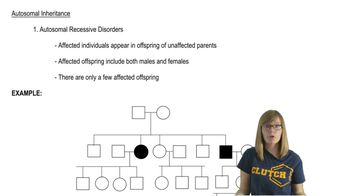
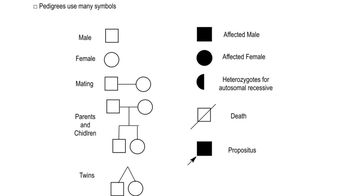
Draw a pedigree of this family, including the woman, the man, their siblings, parents, and grandparents.
A couple and some of their relatives are screened for Gaucher disease in a community-based screening program. The woman is homozygous for the dominant allele, represented by G. The woman's father, sister, and paternal grandmother are heterozygous carriers of the mutant allele, represented by g. Her paternal grandfather, her mother, and both of her mother's parents are homozygous for the dominant allele. The man is heterozygous and he has a brother with Gaucher disease. The man's parents and grandparents have not been tested, but it is known that none of them has Gaucher disease.
On the pedigree, write the genotypes (GG, Gg, or gg) for each person who has been tested or for whom you can deduce a genotype. If a genotype cannot be determined completely, list the alleles you know or deduce must be present.