Pearson+ LogoPearson+ Logo
Ch. 9 - The Molecular Biology of Translation
Sanders - Genetic Analysis: An Integrated Approach 3rd Edition
Sanders3rd EditionGenetic Analysis: An Integrated ApproachISBN: 9780135564172Not the one you use?Change textbook
Chapter 9, Problem 24d

Har Gobind Khorana and his colleagues performed numerous experiments translating synthetic mRNAs. In one experiment, an mRNA molecule with a repeating UG dinucleotide sequence was assembled and translated.
If the genetic code were a doublet code instead of a triplet code, how would the result of this experiment be different?

Verified step by step guidance
1
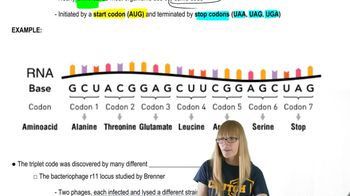
Understand the concept of the genetic code: The genetic code is a triplet code, meaning that three nucleotides (codons) specify one amino acid. If the code were a doublet code, only two nucleotides would specify one amino acid, reducing the number of possible codons.
Analyze the repeating UG dinucleotide sequence: The mRNA sequence in the experiment alternates between U and G, forming a repeating pattern (UGUGUG...). In a triplet code, codons would be read in groups of three nucleotides, such as UGU, GUG, etc. In a doublet code, codons would be read in groups of two nucleotides, such as UG, GU, etc.
Determine the implications of a doublet code: A doublet code would result in fewer possible codons (4^2 = 16 codons) compared to a triplet code (4^3 = 64 codons). This would limit the diversity of amino acids that could be encoded, as there are 20 amino acids in the standard genetic code.
Predict the translation outcome: In a doublet code scenario, the repeating UG sequence would produce fewer distinct codons, potentially leading to a simpler or repetitive polypeptide sequence. For example, UG and GU might correspond to fewer amino acids, resulting in a less complex protein.
Compare to the triplet code result: In the actual experiment with a triplet code, the repeating UG sequence would produce a more diverse set of codons and a more complex polypeptide. This highlights the importance of the triplet code in encoding the full range of amino acids and generating functional proteins.

Verified video answer for a similar problem:

This video solution was recommended by our tutors as helpful for the problem above.
Video duration:
1m
Was this helpful?

Key Concepts

Here are the essential concepts you must grasp in order to answer the question correctly.

Genetic Code

The genetic code is the set of rules by which information encoded in genetic material is translated into proteins. It consists of codons, which are sequences of three nucleotides that correspond to specific amino acids. Understanding the genetic code is crucial for interpreting how mRNA sequences are translated into proteins.
Recommended video:
Guided course
11:43
The Genetic Code

Triplet Code vs. Doublet Code

The triplet code refers to the use of three nucleotides (codons) to specify each amino acid in protein synthesis, allowing for 64 possible combinations. In contrast, a doublet code would use pairs of nucleotides, resulting in only 16 combinations. This difference significantly impacts the diversity of proteins that can be synthesized from mRNA.
Recommended video:
Guided course
11:43
The Genetic Code

Translation Process

Translation is the process by which ribosomes synthesize proteins using mRNA as a template. During translation, the ribosome reads the mRNA codons and assembles the corresponding amino acids into a polypeptide chain. The efficiency and accuracy of translation depend on the structure of the genetic code, which determines how sequences are interpreted.
Recommended video:
Guided course
08:39
mRNA Processing
Related Practice
Textbook Question

Har Gobind Khorana and his colleagues performed numerous experiments translating synthetic mRNAs. In one experiment, an mRNA molecule with a repeating UG dinucleotide sequence was assembled and translated.

Write the sequence of this mRNA and give its polarity.

640
views
Textbook Question

Har Gobind Khorana and his colleagues performed numerous experiments translating synthetic mRNAs. In one experiment, an mRNA molecule with a repeating UG dinucleotide sequence was assembled and translated.

What is the sequence of the resulting polypeptide?

580
views
Textbook Question

Har Gobind Khorana and his colleagues performed numerous experiments translating synthetic mRNAs. In one experiment, an mRNA molecule with a repeating UG dinucleotide sequence was assembled and translated.

How did the polypeptide composition help confirm the triplet nature of the genetic code?

873
views
Textbook Question

Har Gobind Khorana and his colleagues performed numerous experiments translating synthetic mRNAs. In one experiment, an mRNA molecule with a repeating UG dinucleotide sequence was assembled and translated.

If the genetic code were overlapping rather than nonoverlapping, how would the result of this experiment be different?

757
views
Textbook Question

An experiment by Khorana and his colleagues translated a synthetic mRNA containing repeats of the trinucelotide UUG.

How many reading frames are possible in this mRNA?

479
views
Textbook Question

An experiment by Khorana and his colleagues translated a synthetic mRNA containing repeats of the trinucelotide UUG.

What is the result obtained from each reading frame?

595
views