Pearson+ LogoPearson+ Logo
Ch. 9 - The Molecular Biology of Translation
Sanders - Genetic Analysis: An Integrated Approach 3rd Edition
Sanders3rd EditionGenetic Analysis: An Integrated ApproachISBN: 9780135564172Not the one you use?Change textbook
Chapter 9, Problem 24a

Har Gobind Khorana and his colleagues performed numerous experiments translating synthetic mRNAs. In one experiment, an mRNA molecule with a repeating UG dinucleotide sequence was assembled and translated.
Write the sequence of this mRNA and give its polarity.

Verified step by step guidance
1
Understand the problem: The mRNA molecule has a repeating UG dinucleotide sequence. This means the sequence alternates between U (Uracil) and G (Guanine) repeatedly. The task is to write the sequence and determine its polarity.
Step 1: Write the repeating sequence. Since the mRNA is composed of UG dinucleotides, the sequence will look like UGUGUGUG... and continue in this pattern.
Step 2: Recall the polarity of mRNA. mRNA is synthesized in the 5' to 3' direction, which means the sequence starts at the 5' end and ends at the 3' end.
Step 3: Combine the sequence and polarity. The full mRNA sequence will be written as 5'-UGUGUGUG...-3', indicating the directionality of the molecule.
Step 4: Confirm the understanding of polarity. The 5' end refers to the phosphate group attached to the fifth carbon of the ribose sugar, while the 3' end refers to the hydroxyl group attached to the third carbon of the ribose sugar. This polarity is crucial for processes like translation.

Verified video answer for a similar problem:

This video solution was recommended by our tutors as helpful for the problem above.
Video duration:
2m
Was this helpful?

Key Concepts

Here are the essential concepts you must grasp in order to answer the question correctly.

mRNA Structure

Messenger RNA (mRNA) is a single-stranded nucleic acid that carries genetic information from DNA to the ribosome, where proteins are synthesized. It is composed of nucleotide sequences, which include adenine (A), uracil (U), cytosine (C), and guanine (G). The sequence of mRNA is determined by the template strand of DNA during transcription.
Recommended video:
Guided course
03:49
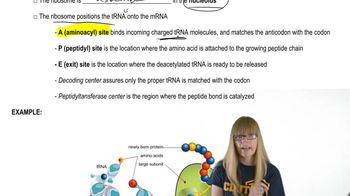
Ribosome Structure

Polarity of Nucleic Acids

Nucleic acids, including mRNA, have polarity, which refers to the directionality of the molecule. mRNA is synthesized in the 5' to 3' direction, meaning that the 5' end has a phosphate group, while the 3' end has a hydroxyl group. This polarity is crucial for the processes of translation and replication.
Recommended video:
Guided course
09:49
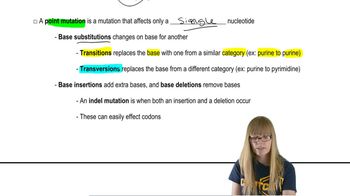
Point Mutations

Codons and Translation

Codons are sequences of three nucleotides in mRNA that correspond to specific amino acids during protein synthesis. The repeating UG dinucleotide sequence in the mRNA would be translated into a series of codons, affecting the resulting polypeptide chain. Understanding how codons are read is essential for predicting the amino acid sequence produced during translation.
Recommended video:
Guided course
07:58
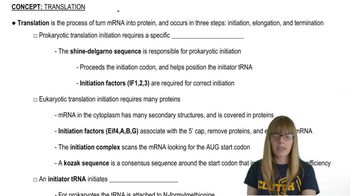
Translation initiation
Related Practice
Textbook Question

Identify and describe the steps that lead to the secretion of proteins from eukaryotic cells.

503
views
Textbook Question

The amino acid sequence of a portion of a polypeptide is

N...Cys-Pro-Ala-Met-Gly-His-Lys...C

What is the mRNA sequence encoding this polypeptide fragment? Use N to represent any nucleotide, Pu to represent a purine, and Py to represent a pyrimidine. Label the 5′ and 3′ ends of the mRNA.

914
views
Textbook Question

The amino acid sequence of a portion of a polypeptide is

N...Cys-Pro-Ala-Met-Gly-His-Lys...C

Give the DNA template and coding strand sequences corresponding to the mRNA. Use the N, Pu, and Py symbols as placeholders.

712
views
Textbook Question

Har Gobind Khorana and his colleagues performed numerous experiments translating synthetic mRNAs. In one experiment, an mRNA molecule with a repeating UG dinucleotide sequence was assembled and translated.

What is the sequence of the resulting polypeptide?

580
views
Textbook Question

Har Gobind Khorana and his colleagues performed numerous experiments translating synthetic mRNAs. In one experiment, an mRNA molecule with a repeating UG dinucleotide sequence was assembled and translated.

How did the polypeptide composition help confirm the triplet nature of the genetic code?

873
views
Textbook Question

Har Gobind Khorana and his colleagues performed numerous experiments translating synthetic mRNAs. In one experiment, an mRNA molecule with a repeating UG dinucleotide sequence was assembled and translated.

If the genetic code were a doublet code instead of a triplet code, how would the result of this experiment be different?

627
views