Pearson+ LogoPearson+ Logo
Ch. 9 - The Molecular Biology of Translation
Sanders - Genetic Analysis: An Integrated Approach 3rd Edition
Sanders3rd EditionGenetic Analysis: An Integrated ApproachISBN: 9780135564172Not the one you use?Change textbook
Chapter 9, Problem 24e

Har Gobind Khorana and his colleagues performed numerous experiments translating synthetic mRNAs. In one experiment, an mRNA molecule with a repeating UG dinucleotide sequence was assembled and translated.
If the genetic code were overlapping rather than nonoverlapping, how would the result of this experiment be different?

Verified step by step guidance
1
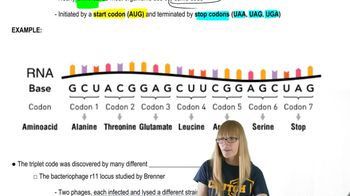
Understand the concept of overlapping versus nonoverlapping genetic code: In a nonoverlapping genetic code, each codon (group of three nucleotides) is read independently, without sharing nucleotides with adjacent codons. In an overlapping genetic code, each nucleotide could be part of multiple codons, meaning the reading frame shifts by one nucleotide for each new codon.
Analyze the synthetic mRNA sequence: The mRNA molecule in the experiment has a repeating UG dinucleotide sequence, which can be represented as UGUGUGUGUG... This sequence will be read in groups of three nucleotides (codons) during translation.
Consider the translation process in a nonoverlapping code: In a nonoverlapping genetic code, the codons would be read as UGUGUG... in groups of three, resulting in specific amino acids based on the genetic code table. Each codon is distinct and does not share nucleotides with adjacent codons.
Consider the translation process in an overlapping code: In an overlapping genetic code, the reading frame shifts by one nucleotide for each new codon. For example, the sequence UGUGUG... would produce codons like UGU, GUG, UGU, GUG... This would result in a different set of amino acids compared to the nonoverlapping code, as the codons are read differently.
Evaluate the experimental outcome: If the genetic code were overlapping, the amino acid sequence produced from the synthetic mRNA would differ significantly from the sequence produced under a nonoverlapping code. This is because the overlapping reading frame changes the codon composition and, consequently, the resulting amino acids.

Verified video answer for a similar problem:

This video solution was recommended by our tutors as helpful for the problem above.
Video duration:
2m
Was this helpful?

Key Concepts

Here are the essential concepts you must grasp in order to answer the question correctly.

Genetic Code

The genetic code is a set of rules that defines how the sequence of nucleotides in mRNA is translated into amino acids, the building blocks of proteins. It consists of codons, which are triplets of nucleotides, each corresponding to a specific amino acid or a stop signal during protein synthesis.
Recommended video:
Guided course
11:43
The Genetic Code

Overlapping vs. Nonoverlapping Code

In a nonoverlapping genetic code, each nucleotide is part of only one codon, meaning that the reading frame shifts by three nucleotides for each new codon. In contrast, an overlapping code allows for shared nucleotides between adjacent codons, which can lead to different amino acid sequences being produced from the same mRNA sequence, significantly altering protein synthesis.
Recommended video:
Guided course
11:43
The Genetic Code

Translation of mRNA

Translation is the process by which ribosomes synthesize proteins using the information encoded in mRNA. During translation, the ribosome reads the mRNA sequence in codons, and tRNA molecules bring the corresponding amino acids to form a polypeptide chain. The structure of the genetic code directly influences the resulting protein's sequence and function.
Recommended video:
Guided course
07:58
Translation initiation
Related Practice
Textbook Question

Har Gobind Khorana and his colleagues performed numerous experiments translating synthetic mRNAs. In one experiment, an mRNA molecule with a repeating UG dinucleotide sequence was assembled and translated.

What is the sequence of the resulting polypeptide?

580
views
Textbook Question

Har Gobind Khorana and his colleagues performed numerous experiments translating synthetic mRNAs. In one experiment, an mRNA molecule with a repeating UG dinucleotide sequence was assembled and translated.

How did the polypeptide composition help confirm the triplet nature of the genetic code?

873
views
Textbook Question

Har Gobind Khorana and his colleagues performed numerous experiments translating synthetic mRNAs. In one experiment, an mRNA molecule with a repeating UG dinucleotide sequence was assembled and translated.

If the genetic code were a doublet code instead of a triplet code, how would the result of this experiment be different?

627
views
Textbook Question

An experiment by Khorana and his colleagues translated a synthetic mRNA containing repeats of the trinucelotide UUG.

How many reading frames are possible in this mRNA?

479
views
Textbook Question

An experiment by Khorana and his colleagues translated a synthetic mRNA containing repeats of the trinucelotide UUG.

What is the result obtained from each reading frame?

595
views
Textbook Question

An experiment by Khorana and his colleagues translated a synthetic mRNA containing repeats of the trinucelotide UUG.

How does the result of this experiment help confirm the triplet nature of the genetic code?

625
views