
Textbook Question
Many biological transformations can be simply classified as additions, eliminations, or substitutions. How would you classify the following reactions?
a. Fumaric acid to malic acid
833
views

 Verified step by step guidance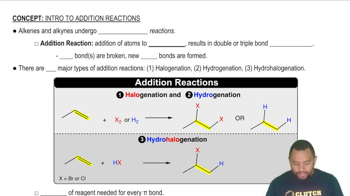
 2:55
2:55
 02:26
02:26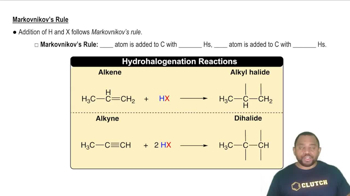 1:37
1:37Many biological transformations can be simply classified as additions, eliminations, or substitutions. How would you classify the following reactions?
a. Fumaric acid to malic acid
In the following addition reactions, are the given alkyl halides obtained as the major products? Give a reason for your answer.
a. 3-Chloro-3-ethylpentane from addition of HCl to 3-ethyl-2-pentene
Classify the following reactions as an addition, elimination, or substitution:
a. CH3Br + NaOH → CH3OH + NaBr
b. H2C═CH2 + HCl → CH3CH2Cl
c. CH3CH2Br → H2C═CH2 + HBr
The structure of vinyl acetate is shown below (the partial structure H2C=CH-is known as a vinyl group). When polymerized it produces poly(vinyl acetate), a polymer used for the springy soles in running shoes. Draw the structure of the polymer obtained if three vinyl acetate units underwent polymerization.
Draw the structures of the two different alkenes from which 3-methyl-3-pentanol, shown in the margin, can be made. Draw them in both condensed and line format.
Many biological transformations can be simply classified as additions, eliminations, or substitutions. How would you classify the following reactions?
b. 2-Phosphoglyceric acid to phosphoenolpyruvic acid