
Pearson+ LogoPearson+ Logo
Ch.6 Chemical Reactions: Mole and Mass Relationships
McMurry - Fundamentals of GOB 8th Edition
McMurry8th EditionFundamentals of GOBISBN: 9780134015187Not the one you use?Change textbook
Chapter 6, Problem 50a

In Problem 6.40, hydrazine reacted with oxygen according to the following (unbalanced) equation: N2H4(l) + O2(g) → NO2(g) + H2O(g)
a. If 75.0 kg of hydrazine are reacted with 75.0 kg of oxygen, which is the limiting reagent?

Verified step by step guidance
1
Step 1: Write the balanced chemical equation for the reaction. To balance the equation, ensure that the number of atoms of each element is the same on both sides of the equation. The balanced equation is: N2H4(l)+2O2(g)NO2(g)+2H2O(g).
Step 2: Convert the given masses of hydrazine (N2H4) and oxygen (O2) into moles. Use the molar masses of N2H4 (32.05 g/mol) and O2 (32.00 g/mol). The formula for converting mass to moles is: moles=massmolar mass.
Step 3: Determine the mole ratio of the reactants from the balanced equation. According to the balanced equation, 1 mole of N2H4 reacts with 2 moles of O2. Compare the actual mole ratio of the reactants (calculated in Step 2) to the stoichiometric ratio to identify the limiting reagent.
Step 4: Calculate the theoretical yield of the products (NO2 and H2O) based on the limiting reagent. Use the stoichiometric coefficients from the balanced equation to determine the moles of products formed per mole of the limiting reagent.
Step 5: Verify your results by ensuring that the limiting reagent is completely consumed in the reaction, while the excess reagent remains partially unreacted. This confirms the identity of the limiting reagent.

Verified video answer for a similar problem:

This video solution was recommended by our tutors as helpful for the problem above.
Video duration:
9m
Was this helpful?

Key Concepts

Here are the essential concepts you must grasp in order to answer the question correctly.

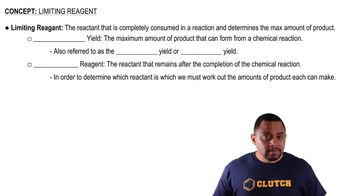
Limiting Reagent

The limiting reagent in a chemical reaction is the substance that is completely consumed first, thus determining the maximum amount of product that can be formed. To identify the limiting reagent, one must compare the mole ratios of the reactants based on the balanced chemical equation. The reactant that produces the least amount of product is the limiting reagent.
Recommended video:
Guided course
01:30
Limiting Reagent

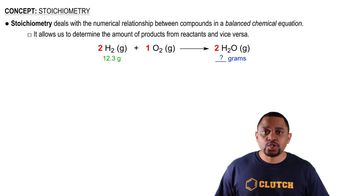
Stoichiometry

Stoichiometry is the calculation of reactants and products in chemical reactions based on the balanced equation. It involves using mole ratios derived from the coefficients of the balanced equation to convert between moles of reactants and products. Understanding stoichiometry is essential for determining how much of each reactant is needed or how much product can be formed.
Recommended video:
Guided course
01:16
Stoichiometry

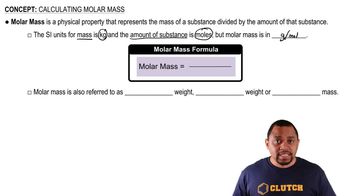
Molar Mass

Molar mass is the mass of one mole of a substance, typically expressed in grams per mole (g/mol). It is crucial for converting between the mass of a substance and the number of moles, which is necessary for stoichiometric calculations. To find the limiting reagent, one must first calculate the molar masses of the reactants to determine how many moles are present in the given masses.
Recommended video:
Guided course
01:10
Calculating Molar Mass
Related Practice
Textbook Question

Titanium metal is obtained from the mineral rutile, TiO2. The process requires multiple steps, as shown in the following reactions:

TiO2(s) + 2 Cl2(g) + 2 C(s) → TiCl4(s) + 2 CO(g)

TiCl4(s) + 2 Mg(s) → Ti(s) + 2 MgCl2(s)

a. Write mole ratios to show the relationship between the reactants and products for each reaction.

1808
views
Textbook Question

Titanium metal is obtained from the mineral rutile, TiO2. The process requires multiple steps, as shown in the following reactions:

TiO2(s) + 2 Cl2(g) + 2 C(s) → TiCl4(s) + 2 CO(g)

TiCl4(s) + 2 Mg(s) → Ti(s) + 2 MgCl2(s)

b. How many moles of TiO2 are needed to form one mole of titanium?

1870
views
Textbook Question

Titanium metal is obtained from the mineral rutile, TiO2. The process requires multiple steps, as shown in the following reactions:

TiO2(s) + 2 Cl2(g) + 2 C(s) → TiCl4(s) + 2 CO(g)

TiCl4(s) + 2 Mg(s) → Ti(s) + 2 MgCl2(s)

c. How many kilograms of rutile are needed to produce 95 kg of Ti?

1552
views
Textbook Question

Nitrobenzene (C6H5NO2) is used in small quantities as a flavoring agent or in perfumes but can be toxic in large amounts. It is produced by reaction of benzene (C6H6) with nitric acid:

C6H6(l) + HNO3(aq) → C6H5NO2(l) + H2O(l)

a. Identify the limiting reagent in the reaction of 27.5 g of nitric acid with 75 g of benzene.

2148
views
Textbook Question

Nitrobenzene (C6H5NO2) is used in small quantities as a flavoring agent or in perfumes but can be toxic in large amounts. It is produced by reaction of benzene (C6H6) with nitric acid:

C6H6(l) + HNO3(aq) → C6H5NO2(l) + H2O(l)

b. Calculate the theoretical yield for this reaction.

2158
views
Textbook Question

When table sugar (sucrose, C12H22O11) is heated, it decomposes to form C and H2O.

a. Write a balanced equation for the process.

2599
views