Pearson+ LogoPearson+ Logo
Ch.11 Nuclear Chemistry
McMurry - Fundamentals of GOB 8th Edition
McMurry8th EditionFundamentals of GOBISBN: 9780134015187Not the one you use?Change textbook
Chapter 11, Problem 29

What is wrong with the following decay curve? Explain. Decay curve showing sample remaining over time in hours for nuclear chemistry.

Verified step by step guidance
1
Identify the type of decay process represented by the curve. Typically, decay curves are exponential, representing processes like radioactive decay or first-order chemical reactions.
Observe the shape of the curve. In a typical exponential decay, the curve should approach zero asymptotically, meaning it never actually reaches zero but gets infinitely close.
Check the y-axis values. The graph shows the sample remaining in grams per 100 grams of the sample. In a proper decay curve, the values should decrease continuously and never become negative.
Analyze the x-axis values. The time should be consistent with the half-life or decay constant of the substance, showing a consistent rate of decay over time.
Evaluate the end behavior of the curve. The curve should not flatten out completely if it represents a true decay process, as this would imply the sample stops decaying, which is not typical for exponential decay.

Verified video answer for a similar problem:

This video solution was recommended by our tutors as helpful for the problem above.
Video duration:
2m
Was this helpful?

Key Concepts

Here are the essential concepts you must grasp in order to answer the question correctly.

Radioactive Decay

Radioactive decay is the process by which an unstable atomic nucleus loses energy by emitting radiation. This decay occurs at a predictable rate, characterized by the half-life, which is the time required for half of the radioactive sample to decay. Understanding this concept is crucial for analyzing decay curves, as they typically exhibit an exponential decrease in the quantity of the sample over time.
Recommended video:
Guided course
02:52
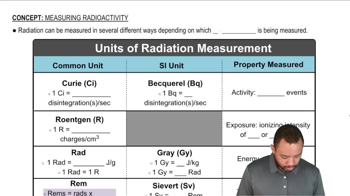
Measuring Radioactivity Concept 1

Decay Curve

A decay curve graphically represents the amount of a radioactive substance remaining over time. It typically shows a steep decline initially, which gradually levels off as the sample approaches stability. Analyzing the shape and behavior of the curve helps identify inconsistencies or errors in the data, such as deviations from expected exponential decay patterns.
Recommended video:
Guided course
05:54
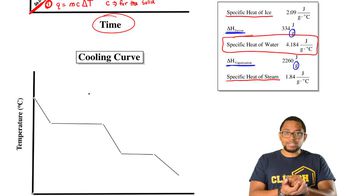
Heating and Cooling Curves Concept 2

Exponential Decay

Exponential decay describes a process where the quantity decreases at a rate proportional to its current value. In the context of radioactive decay, this means that the sample's remaining amount decreases rapidly at first and then slows down over time. A proper decay curve should reflect this behavior; any linear or non-exponential trends may indicate errors in measurement or interpretation.
Recommended video:
Guided course
06:46
Beta Decay Example 2