Pearson+ LogoPearson+ Logo
Ch.19 Enzymes and Vitamins
McMurry - Fundamentals of GOB 8th Edition
McMurry8th EditionFundamentals of GOBISBN: 9780134015187Not the one you use?Change textbook
Chapter 19, Problem 29b

Explain how the following mechanisms regulate enzyme activity.
b. Genetic control

Verified step by step guidance
1
Understand that genetic control refers to the regulation of enzyme activity at the level of gene expression, meaning the production of enzymes is controlled by turning genes on or off.
Recognize that genes encode the instructions for synthesizing enzymes, and their expression can be influenced by factors such as environmental signals, cellular needs, or developmental stages.
Explain that when a gene is 'turned on' (expressed), the cell produces messenger RNA (mRNA) through transcription, which is then translated into the enzyme protein. Conversely, when a gene is 'turned off,' no enzyme is produced.
Discuss how genetic control can be a long-term regulatory mechanism, as it affects the amount of enzyme available in the cell rather than modifying the activity of existing enzymes.
Provide examples, such as the regulation of enzymes involved in lactose metabolism in bacteria (e.g., the lac operon), where the presence or absence of lactose determines whether the genes for lactose-digesting enzymes are expressed.

Verified video answer for a similar problem:

This video solution was recommended by our tutors as helpful for the problem above.
Video duration:
5m
Was this helpful?

Key Concepts

Here are the essential concepts you must grasp in order to answer the question correctly.

Enzyme Regulation

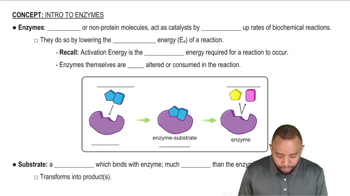
Enzyme regulation refers to the various mechanisms that control the activity of enzymes, ensuring that metabolic processes occur at the right time and in the right amounts. This regulation can occur through several means, including allosteric regulation, covalent modification, and genetic control, which collectively help maintain homeostasis within the cell.
Recommended video:
Guided course
2:14
Intro to Enzymes Concept 1

Genetic Control

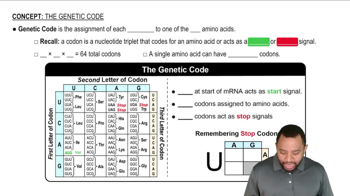
Genetic control of enzyme activity involves the regulation of gene expression that encodes enzymes. This means that the synthesis of enzymes can be increased or decreased based on the cell's needs, often in response to environmental changes or developmental signals, allowing for precise control over metabolic pathways.
Recommended video:
Guided course
03:25
The Genetic Code Concept 1

Transcription and Translation

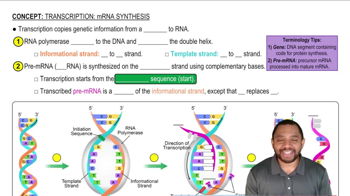
Transcription and translation are the two key processes through which genetic information is converted into functional proteins, including enzymes. Transcription involves copying DNA into messenger RNA (mRNA), while translation is the process where ribosomes synthesize proteins based on the sequence of the mRNA, ultimately determining the levels of enzyme activity in the cell.
Recommended video:
Guided course
6:37
Transcription: mRNA Synthesis Concept 1