Pearson+ LogoPearson+ Logo
Ch.11 Nucleic Acids Big Molecules with a Big Role
Frost - General, Organic and Biological Chemistry 4th Edition
Frost4th EditionGeneral, Organic and Biological ChemistryISBN: 9780134988696Not the one you use?Change textbook
Chapter 7, Problem 21

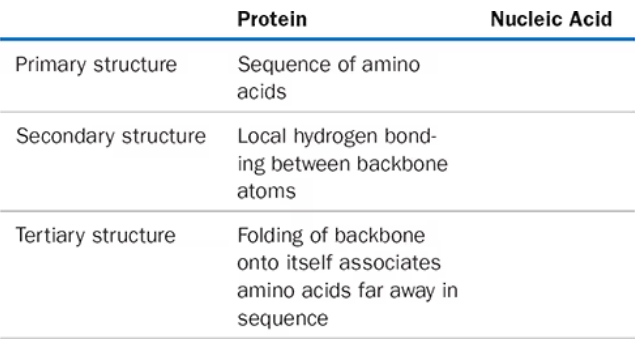
Fill in the following table with the analogous nucleic acid structures:

Verified step by step guidance
1
Identify the nucleic acid structures in the image provided. These could include components such as nitrogenous bases, sugar molecules, and phosphate groups.
Determine the type of nucleic acid (DNA or RNA) based on the structures shown. For example, DNA contains deoxyribose sugar, while RNA contains ribose sugar.
Match each component in the image to its analogous structure in the nucleic acid. For instance, adenine pairs with thymine in DNA and with uracil in RNA.
Fill in the table by labeling each structure with its corresponding name and function (e.g., nitrogenous base, sugar, phosphate group).
Double-check the completed table to ensure all structures are correctly identified and labeled according to their roles in nucleic acids.

Verified video answer for a similar problem:

This video solution was recommended by our tutors as helpful for the problem above.
Video duration:
5m
Was this helpful?

Key Concepts

Here are the essential concepts you must grasp in order to answer the question correctly.

Nucleic Acids

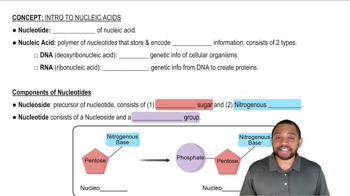
Nucleic acids, primarily DNA and RNA, are biopolymers essential for all known forms of life. They are composed of nucleotide monomers, which include a sugar, a phosphate group, and a nitrogenous base. DNA stores genetic information, while RNA plays a crucial role in protein synthesis and gene expression.
Recommended video:
Guided course
1:55
Intro to Nucleic Acids Concept 1

Base Pairing

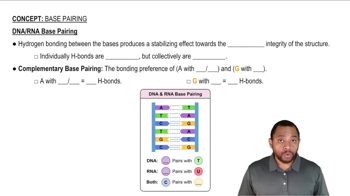
Base pairing refers to the specific hydrogen bonding between nitrogenous bases in nucleic acids. In DNA, adenine pairs with thymine, and cytosine pairs with guanine, while in RNA, adenine pairs with uracil instead of thymine. This complementary pairing is fundamental for the structure of DNA and the function of RNA.
Recommended video:
Guided course
2:56
Base Pairing Concept 1

Nucleotide Structure

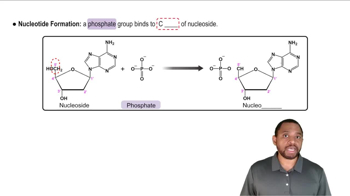
A nucleotide is the basic building block of nucleic acids, consisting of three components: a five-carbon sugar (deoxyribose in DNA and ribose in RNA), a phosphate group, and a nitrogenous base. The arrangement of these components determines the identity and function of the nucleic acid, influencing processes like replication and transcription.
Recommended video:
Guided course
1:19
Nucleoside and Nucleotide Formation Concept 2