Pearson+ LogoPearson+ Logo
Ch.11 Nucleic Acids Big Molecules with a Big Role
Frost - General, Organic and Biological Chemistry 4th Edition
Frost4th EditionGeneral, Organic and Biological ChemistryISBN: 9780134988696Not the one you use?Change textbook
Chapter 7, Problem 22

List the similarities and differences in the secondary structure of a protein and the secondary structure of DNA.

Verified step by step guidance
1
Identify the components of the secondary structure in proteins, which include alpha helices and beta sheets, stabilized by hydrogen bonds between the backbone atoms.
Recognize that the secondary structure of DNA is primarily the double helix, stabilized by hydrogen bonds between complementary base pairs (adenine-thymine and guanine-cytosine) and base stacking interactions.
Note that both protein and DNA secondary structures are stabilized by hydrogen bonds, but the specific interactions and components involved differ.
Understand that protein secondary structures are formed by the folding of polypeptide chains, while DNA secondary structure involves the pairing and twisting of two nucleotide strands.
Highlight that the function of these structures differs: protein secondary structures contribute to the overall 3D shape and function of the protein, while DNA's double helix structure is crucial for genetic information storage and replication.

Verified video answer for a similar problem:

This video solution was recommended by our tutors as helpful for the problem above.
Video duration:
3m
Was this helpful?

Key Concepts

Here are the essential concepts you must grasp in order to answer the question correctly.

Secondary Structure of Proteins

The secondary structure of proteins refers to the local folded structures that form within a polypeptide due to hydrogen bonding between the backbone atoms. The most common types are alpha helices and beta sheets. These structures are crucial for the overall shape and function of proteins, influencing how they interact with other molecules.
Recommended video:
Guided course
1:24
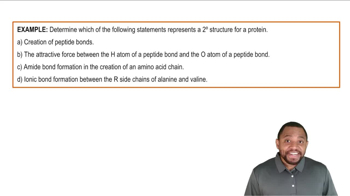
Secondary Protein Structure Example 2

Secondary Structure of DNA

The secondary structure of DNA primarily refers to its double helix formation, which is stabilized by hydrogen bonds between complementary base pairs. This structure allows for the efficient storage and transmission of genetic information. The helical shape and the antiparallel orientation of the two strands are key features that distinguish DNA's secondary structure.
Recommended video:
Guided course
1:24
Secondary Protein Structure Example 2

Comparative Analysis

Comparative analysis involves examining the similarities and differences between the secondary structures of proteins and DNA. While both involve hydrogen bonding and contribute to the stability of the molecule, proteins can adopt a variety of secondary structures, whereas DNA predominantly exists as a double helix. Understanding these distinctions is essential for grasping their respective biological functions.
Recommended video:
Guided course
06:11
Dimensional Analysis