Draw structures for molecules that fit the following descriptions: (a) C3H6O containing an aldehyde functional group
Verified step by step guidance
1
Step 1: Understand the molecular formula C3H6O. This indicates the molecule contains 3 carbon atoms, 6 hydrogen atoms, and 1 oxygen atom.
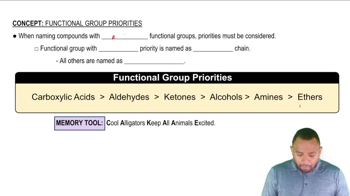
Step 2: Recall the structure of an aldehyde functional group. An aldehyde contains a carbonyl group (C=O) bonded to at least one hydrogen atom. The general formula for an aldehyde is R-CHO, where R is a hydrocarbon group.
Step 3: Arrange the 3 carbon atoms in a chain. Since the aldehyde group must be at the end of the chain, place the carbonyl group (C=O) on one of the terminal carbons, and attach a hydrogen atom to the same carbon to complete the aldehyde group.
Step 4: Distribute the remaining hydrogen atoms to the other two carbons in the chain to satisfy the octet rule for each carbon atom. Ensure that each carbon has four bonds in total.
Step 5: Verify the structure by counting the total number of carbon, hydrogen, and oxygen atoms to ensure it matches the molecular formula C3H6O, and confirm the presence of the aldehyde functional group.
Verified video answer for a similar problem:
This video solution was recommended by our tutors as helpful for the problem above
Play a video:
Was this helpful?
Key Concepts
Here are the essential concepts you must grasp in order to answer the question correctly.
Aldehyde Functional Group
An aldehyde is a type of organic compound characterized by the presence of a carbonyl group (C=O) bonded to a terminal carbon atom. This means that the carbonyl group is located at the end of the carbon chain, which distinguishes aldehydes from ketones, where the carbonyl group is found within the chain. Aldehydes typically have the general formula RCHO, where R represents a hydrocarbon group.
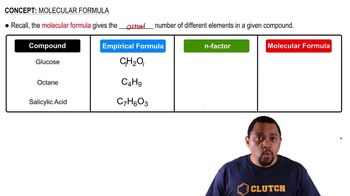
The molecular formula C3H6O indicates that the molecule contains three carbon atoms, six hydrogen atoms, and one oxygen atom. Understanding how to interpret this formula is crucial for constructing the molecular structure, as it provides insight into the number of bonds and the arrangement of atoms. The presence of fewer hydrogen atoms relative to carbon suggests the potential for functional groups, such as the aldehyde in this case.
Drawing structures for organic molecules involves representing the arrangement of atoms and the types of bonds between them. This can be done using various methods, such as Lewis structures or skeletal formulas. For the given molecular formula C3H6O with an aldehyde group, one must ensure that the carbonyl group is positioned at the end of the carbon chain while satisfying the tetravalency of carbon and the valency of other atoms involved.