Pearson+ LogoPearson+ Logo
Ch.4 Introduction to Organic Compounds
Frost - General, Organic and Biological Chemistry 4th Edition
Frost4th EditionGeneral, Organic and Biological ChemistryISBN: 9780134988696Not the one you use?Change textbook
Chapter 1, Problem 41a

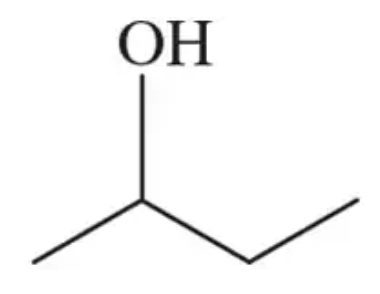
Convert the skeletal structures shown to condensed structures.
(a) Skeletal structure of an organic compound with an OH group, illustrating the conversion to a condensed formula.

Verified step by step guidance
1
Identify the skeletal structure in the image. Skeletal structures represent organic molecules where carbon atoms are implied at the ends and intersections of lines, and hydrogen atoms are implied to complete the valency of carbon.
Determine the number of carbon atoms in the structure by counting the vertices and ends of the lines in the skeletal structure.
For each carbon atom, calculate the number of hydrogen atoms needed to satisfy the carbon's valency of four. Remember that each line connected to a carbon represents a bond to another atom (either carbon or another element).
Write the condensed structure by explicitly listing each carbon atom and its attached hydrogens in the format CHₓ, where x is the number of hydrogens. If there are functional groups or other atoms attached, include them in the appropriate position.
Double-check the condensed structure to ensure it matches the skeletal structure, verifying that all bonds and atoms are accounted for and that the valency of each atom is satisfied.

Verified video answer for a similar problem:

This video solution was recommended by our tutors as helpful for the problem above.
Video duration:
1m
Was this helpful?

Key Concepts

Here are the essential concepts you must grasp in order to answer the question correctly.

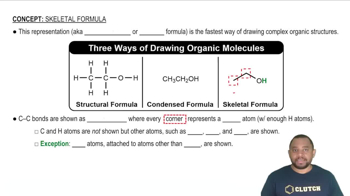
Skeletal Structures

Skeletal structures represent organic molecules using lines and vertices to indicate bonds and atoms, respectively. Each vertex corresponds to a carbon atom, while the ends of lines represent functional groups or other atoms. This representation simplifies complex molecular structures, making it easier to visualize connectivity without showing every atom explicitly.
Recommended video:
Guided course
2:26
Skeletal Formula Concept 1

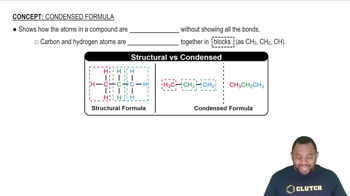
Condensed Structures

Condensed structures provide a more compact representation of molecules by grouping atoms together and indicating connectivity without drawing all bonds. In this format, atoms are listed in a way that reflects their connectivity, often using parentheses to denote branching or functional groups. This method is useful for quickly conveying the structure of a molecule in a more readable format.
Recommended video:
Guided course
1:53
Condensed Formula Concept 1

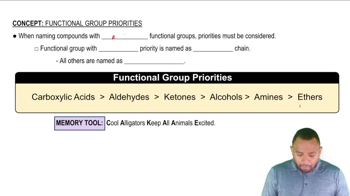
Functional Groups

Functional groups are specific groups of atoms within molecules that are responsible for the characteristic chemical reactions of those molecules. They determine the properties and reactivity of organic compounds. Recognizing functional groups is essential when converting skeletal structures to condensed structures, as they often dictate how the molecule is represented and understood.
Recommended video:
Guided course
1:11
Functional Group Priorities Concept 1