Pearson+ LogoPearson+ Logo
Ch.6 Carbohydrates Life's Sweet Molecules
Frost - General, Organic and Biological Chemistry 4th Edition
Frost4th EditionGeneral, Organic and Biological ChemistryISBN: 9780134988696Not the one you use?Change textbook
Chapter 3, Problem 17b

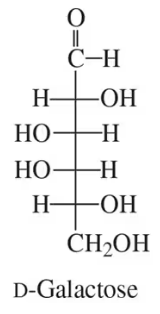
Use the structure of d-galactose in Problem 6.15 to answer the following: 
Fischer projection of d-galactose, showing its molecular structure and functional groups.
(b) Draw the Fischer projection of L-galactose.

Verified step by step guidance
1
Understand the structure of D-galactose: D-galactose is an aldohexose, meaning it has six carbon atoms and an aldehyde functional group. In the Fischer projection, the hydroxyl (-OH) groups are arranged in a specific orientation around the chiral carbons.
Recall the relationship between D- and L-forms of sugars: The L-form of a sugar is the mirror image of the D-form. This means that the configuration of the hydroxyl groups on each chiral carbon is reversed in the L-form compared to the D-form.
Identify the chiral centers in D-galactose: D-galactose has four chiral centers (carbon atoms 2, 3, 4, and 5). The orientation of the hydroxyl groups at these positions determines the stereochemistry of the molecule.
Reverse the configuration of the hydroxyl groups: To draw L-galactose, reverse the positions of the hydroxyl groups on each chiral center in the Fischer projection of D-galactose. For example, if the hydroxyl group is on the right in the D-form, it will be on the left in the L-form.
Draw the Fischer projection of L-galactose: Arrange the carbon chain vertically, with the aldehyde group at the top (C1) and the CH2OH group at the bottom (C6). Place the hydroxyl groups in their reversed positions compared to D-galactose, ensuring the mirror image configuration is accurately represented.

Verified video answer for a similar problem:

This video solution was recommended by our tutors as helpful for the problem above.
Video duration:
2m
Was this helpful?

Key Concepts

Here are the essential concepts you must grasp in order to answer the question correctly.

Fischer Projection

The Fischer projection is a two-dimensional representation of a molecule, particularly used for carbohydrates and amino acids. In this format, the vertical lines represent bonds that are oriented away from the viewer, while horizontal lines represent bonds that are coming towards the viewer. This method helps in visualizing the stereochemistry of chiral centers in a compound.
Recommended video:
Guided course
0:48
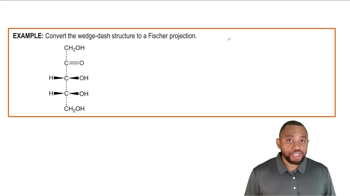
Fischer Projections Example 1

D-Galactose Structure

D-Galactose is a monosaccharide that is an epimer of glucose, differing at one specific carbon atom. It has a six-carbon structure (C6H12O6) and is an important component of lactose. Understanding its structure is crucial for drawing its stereoisomer, L-galactose, as it involves recognizing the orientation of hydroxyl groups around the chiral centers.
Recommended video:
Guided course
0:56
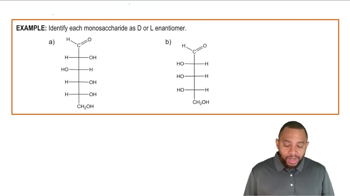
D vs L Enantiomers Example 1

Stereochemistry

Stereochemistry is the study of the spatial arrangement of atoms in molecules and how this affects their chemical properties and reactions. In carbohydrates like galactose, stereochemistry is vital for distinguishing between different isomers, such as D and L forms, which have different biological activities. Recognizing the importance of stereochemistry is essential for accurately drawing and interpreting molecular structures.
Recommended video:
Guided course
1:30
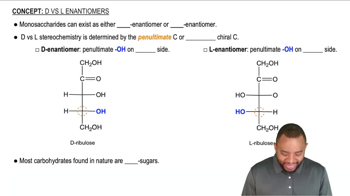
D vs L Enantiomers Concept 1