


Based on bond energies, which atmospheric gas in each pair do you think is more stable? Explain. a. O2 or N2 b. CO or CO2
Verified step by step guidance
1
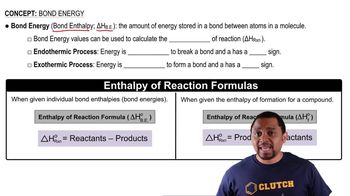
Step 1: Understand the concept of bond energy. Bond energy is the amount of energy required to break one mole of a specific type of bond in a molecule in the gas phase. Higher bond energy indicates a stronger bond and greater stability of the molecule.
Step 2: Compare the bond energies of the molecules in part (a). For O₂, the bond is a double bond (O=O), while for N₂, the bond is a triple bond (N≡N). Triple bonds are stronger than double bonds, so N₂ has a higher bond energy and is more stable than O₂.
Step 3: Compare the bond energies of the molecules in part (b). For CO, the bond is a triple bond (C≡O), while for CO₂, the molecule contains two double bonds (O=C=O). Although CO₂ has two bonds, the individual double bonds are weaker than the triple bond in CO. Therefore, CO is more stable than CO₂ based on bond energy.
Step 4: Consider the molecular structure and bond strength in each case. Stability is directly related to the strength of the bonds within the molecule. Molecules with stronger bonds (higher bond energy) are less likely to break apart and are thus more stable.
Step 5: Summarize the findings. For part (a), N₂ is more stable than O₂ due to its triple bond. For part (b), CO is more stable than CO₂ due to its triple bond compared to the double bonds in CO₂.
Verified video answer for a similar problem:
This video solution was recommended by our tutors as helpful for the problem above
Video duration:
48s
Play a video:
Was this helpful?
Key Concepts
Here are the essential concepts you must grasp in order to answer the question correctly.
Bond Energy
Bond energy refers to the amount of energy required to break a bond between two atoms in a molecule. It is a measure of bond strength; higher bond energies indicate stronger bonds. Understanding bond energies is crucial for comparing the stability of different molecules, as more stable molecules typically have higher bond energies, making them less likely to react.
Molecular stability is determined by the strength of the bonds within a molecule and the overall energy state of the molecule. A more stable molecule has lower energy and is less reactive, meaning it is less likely to undergo chemical changes. Stability can be influenced by factors such as bond type, molecular structure, and the presence of functional groups.
Comparative analysis of gases involves evaluating the properties of different gases to determine their relative stability and reactivity. In the context of the question, this means assessing the bond energies of O2 versus N2 and CO versus CO2. By comparing these properties, one can infer which gas is more stable based on its molecular structure and bond strengths.