Pearson+ LogoPearson+ Logo
Ch.15 Aldehydes and Ketones
McMurry - Fundamentals of GOB 8th Edition
McMurry8th EditionFundamentals of GOBISBN: 9780134015187Not the one you use?Change textbook
Chapter 15, Problem 31b

Draw structures corresponding to the following aldehyde and ketone names:
b. 4-Ethyl-2-isopropylhexanal

Verified step by step guidance
1
Identify the parent chain: The name 'hexanal' indicates that the parent chain is a six-carbon chain (hex-) with an aldehyde functional group (-al) at carbon 1.
Number the carbon chain: Start numbering the chain from the carbon of the aldehyde group, as it has the highest priority.
Locate and add substituents: The name specifies two substituents: a 4-ethyl group (a two-carbon chain attached to carbon 4) and a 2-isopropyl group (a three-carbon branched group attached to carbon 2).
Draw the structure: Begin with the six-carbon chain, place the aldehyde group at carbon 1, and then add the ethyl group at carbon 4 and the isopropyl group at carbon 2.
Double-check the structure: Ensure that all carbons have the correct number of bonds (four for carbon), the aldehyde group is correctly placed at carbon 1, and the substituents are positioned as specified in the name.

Verified video answer for a similar problem:

This video solution was recommended by our tutors as helpful for the problem above.
Was this helpful?

Key Concepts

Here are the essential concepts you must grasp in order to answer the question correctly.

Aldehyde Structure

Aldehydes are organic compounds characterized by the presence of a carbonyl group (C=O) at the end of a carbon chain. The general formula for aldehydes is R-CHO, where R represents a hydrocarbon chain. Understanding the structure of aldehydes is crucial for drawing their chemical representations, as the position of the carbonyl group influences the naming and properties of the compound.
Recommended video:
Guided course
0:34
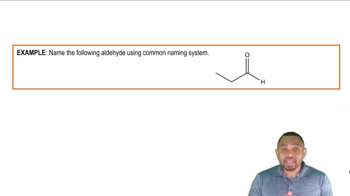
Naming Aldehydes Example 2

IUPAC Nomenclature

IUPAC nomenclature is a systematic method for naming organic chemical compounds. It provides rules for identifying the longest carbon chain, substituents, and functional groups, which are essential for accurately naming and drawing structures. In the case of '4-Ethyl-2-isopropylhexanal', recognizing the position of substituents and the functional group is vital for constructing the correct molecular structure.
Recommended video:
Guided course
3:18
IUPAC Naming Concept 3

Structural Representation

Structural representation refers to the way in which the arrangement of atoms in a molecule is depicted. This can include line-angle formulas, condensed formulas, or three-dimensional models. For the compound '4-Ethyl-2-isopropylhexanal', accurately representing the branching and functional groups in the structure is essential for visualizing its chemical properties and reactivity.
Recommended video:
Guided course
2:08
Molecular Representations Concept 1