Pearson+ LogoPearson+ Logo
Ch.12 Introduction to Organic Chemistry: Alkanes
McMurry - Fundamentals of GOB 8th Edition
McMurry8th EditionFundamentals of GOBISBN: 9780134015187Not the one you use?Change textbook
Chapter 12, Problem 46a

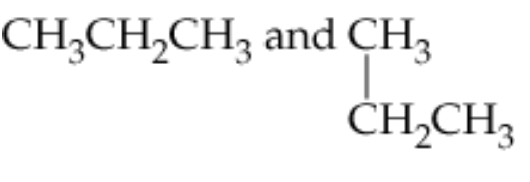
Which of the following pairs of structures are identical, which are isomers, and which are unrelated?
a. Chemical structures labeled as CH3CH2CH3 and CH3 with a vertical bond to CH2CH3, questioning their relationship.

Verified step by step guidance
1
Examine the structures in the image carefully. Look for similarities and differences in the arrangement of atoms, functional groups, and connectivity between the atoms.
Determine if the two structures have the same molecular formula. If they do not, they are unrelated. If they do, proceed to the next step.
Check the connectivity of the atoms in each structure. If the atoms are connected in the same way, the structures are identical. If the connectivity differs, proceed to the next step.
Analyze the spatial arrangement of the atoms (if stereochemistry is shown). If the connectivity is the same but the spatial arrangement differs (e.g., cis/trans isomers or enantiomers), the structures are isomers.
Conclude whether the structures are identical, isomers, or unrelated based on the analysis of molecular formula, connectivity, and spatial arrangement.

Verified video answer for a similar problem:

This video solution was recommended by our tutors as helpful for the problem above.
Was this helpful?

Key Concepts

Here are the essential concepts you must grasp in order to answer the question correctly.

Identical Structures

Identical structures refer to molecules that have the same molecular formula and the same arrangement of atoms. These structures are essentially the same in every aspect, including their physical and chemical properties. For example, two molecules of water (H2O) are identical as they have the same composition and structure.
Recommended video:
Guided course
1:01
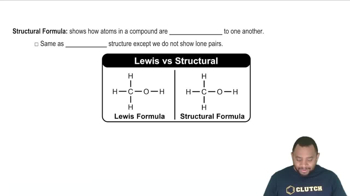
Structural Formula Concept 2

Isomers

Isomers are compounds that share the same molecular formula but differ in the arrangement of atoms, leading to different structural or spatial configurations. This can result in variations in physical and chemical properties. For instance, glucose and fructose are isomers, both having the formula C6H12O6 but differing in structure and properties.
Recommended video:
Guided course
2:16
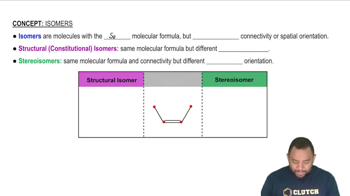
Isomers Concept 1

Unrelated Structures

Unrelated structures are compounds that do not share the same molecular formula or structural characteristics. These molecules are distinct in their composition and properties, making them fundamentally different. An example would be comparing water (H2O) and carbon dioxide (CO2), which have entirely different formulas and functions.
Recommended video:
Guided course
1:01
Structural Formula Concept 2