Pearson+ LogoPearson+ Logo
Ch.12 Introduction to Organic Chemistry: Alkanes
McMurry - Fundamentals of GOB 8th Edition
McMurry8th EditionFundamentals of GOBISBN: 9780134015187Not the one you use?Change textbook
Chapter 12, Problem 12a

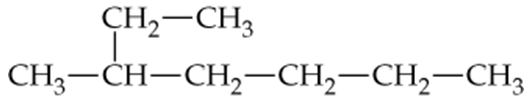
What are the IUPAC names of the following alkanes?
a.

Verified step by step guidance
1
Identify the longest continuous carbon chain in each structure. This chain determines the base name of the alkane (e.g., methane, ethane, propane, etc.).
Number the carbon atoms in the longest chain, starting from the end nearest to the first substituent group. This ensures the substituents have the lowest possible numbers.
Identify and name all substituent groups attached to the main chain. Substituents are named based on the number of carbons they contain (e.g., methyl for CH₃, ethyl for C₂H₅).
Combine the names of the substituents with the base name of the alkane. Use prefixes (di-, tri-, etc.) if there are multiple identical substituents, and list substituents in alphabetical order.
Write the full IUPAC name by placing the substituent names (with their position numbers) before the base name of the alkane. Use hyphens to separate numbers from words and commas to separate multiple numbers.

Verified video answer for a similar problem:

This video solution was recommended by our tutors as helpful for the problem above.
Was this helpful?

Key Concepts

Here are the essential concepts you must grasp in order to answer the question correctly.

IUPAC Nomenclature

IUPAC nomenclature is a systematic method for naming chemical compounds, particularly organic molecules. It provides a set of rules to create unique names based on the structure of the compound, ensuring that each name conveys specific information about the molecule's composition and arrangement. Understanding these rules is essential for accurately identifying and communicating about alkanes and other organic compounds.
Recommended video:
Guided course
3:18
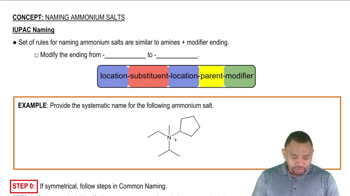
IUPAC Naming Concept 3

Alkanes

Alkanes are a class of hydrocarbons characterized by single bonds between carbon atoms and a general formula of CnH2n+2. They are saturated compounds, meaning they contain the maximum number of hydrogen atoms possible for a given number of carbon atoms. Recognizing the structure and properties of alkanes is crucial for determining their IUPAC names.
Recommended video:
Guided course
1:20
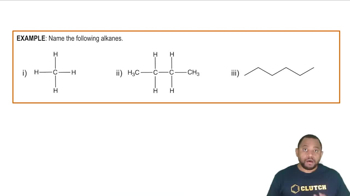
Naming Alkanes Example 1

Structural Isomers

Structural isomers are compounds that have the same molecular formula but different structural arrangements of atoms. In the context of alkanes, this means that multiple alkanes can share the same formula while differing in their connectivity, leading to different IUPAC names. Understanding structural isomerism is important for accurately naming and distinguishing between various alkanes.
Recommended video:
Guided course
2:16
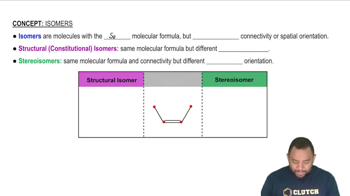
Isomers Concept 1