Pearson+ LogoPearson+ Logo
Ch.17 Carboxylic Acids and Their Derivatives
McMurry - Fundamentals of GOB 8th Edition
McMurry8th EditionFundamentals of GOBISBN: 9780134015187Not the one you use?Change textbook
Chapter 17, Problem 9c

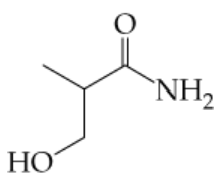
What are the names of the following compounds?
c. Chemical structure of an amide with a hydroxyl group and an amine group attached to a carbon chain.

Verified step by step guidance
1
Step 1: Analyze the image provided in the problem to identify the structural formula or molecular representation of the compound. Look for functional groups, carbon chains, and any substituents present.
Step 2: Determine the parent chain of the compound. The parent chain is the longest continuous chain of carbon atoms, which will form the base name of the compound.
Step 3: Identify and name any functional groups or substituents attached to the parent chain. Functional groups often determine the suffix of the compound's name, while substituents are named as prefixes.
Step 4: Assign locants (numbers) to the carbon atoms in the parent chain to indicate the positions of substituents or functional groups. Use the lowest possible numbers to ensure proper IUPAC naming.
Step 5: Combine the names of the substituents, parent chain, and functional groups into the full IUPAC name of the compound. Ensure the name follows the correct order and format (e.g., substituents listed alphabetically, hyphens and commas used appropriately).

Verified video answer for a similar problem:

This video solution was recommended by our tutors as helpful for the problem above.
Was this helpful?

Key Concepts

Here are the essential concepts you must grasp in order to answer the question correctly.

Chemical Nomenclature

Chemical nomenclature is the systematic naming of chemical compounds based on established rules. It allows chemists to communicate clearly about substances, ensuring that each compound has a unique name that reflects its structure and composition. The International Union of Pure and Applied Chemistry (IUPAC) provides guidelines for naming organic and inorganic compounds.
Recommended video:
Guided course
00:58
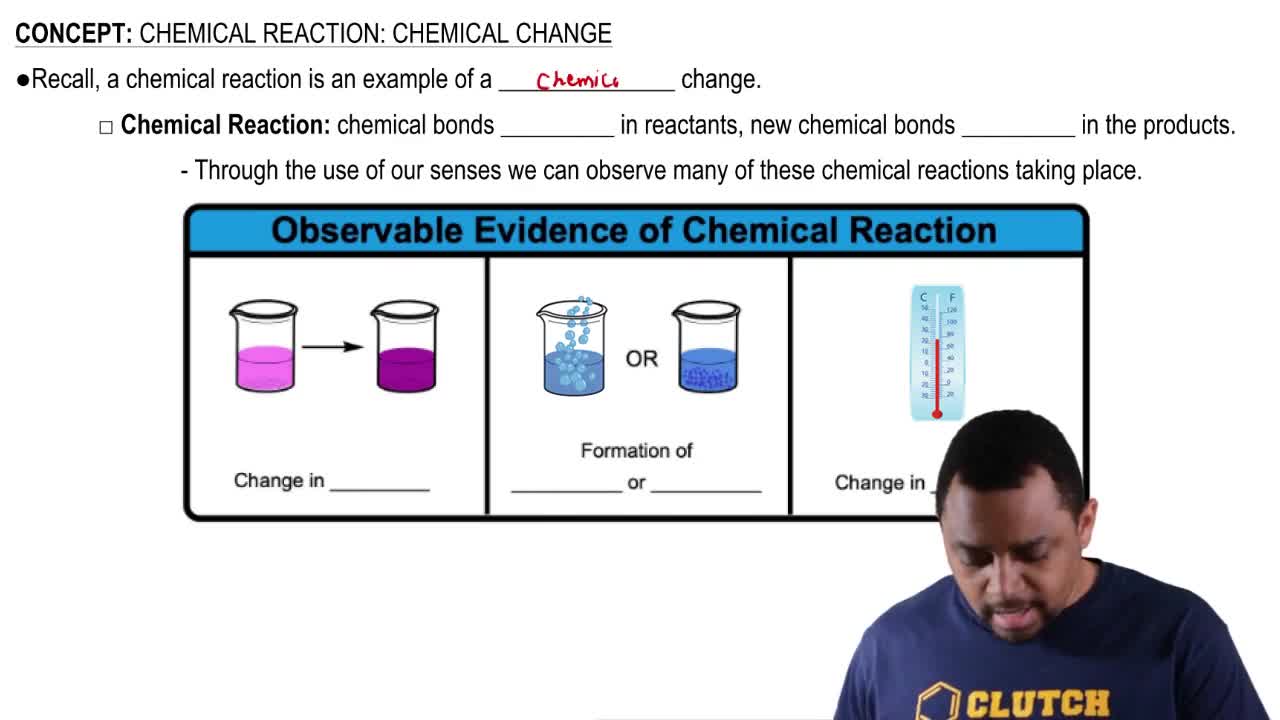
Chemical Reaction: Chemical Change Concept 1

Functional Groups

Functional groups are specific groups of atoms within molecules that are responsible for the characteristic chemical reactions of those molecules. Understanding functional groups is essential for naming organic compounds, as they determine the compound's reactivity and properties. Common functional groups include hydroxyl (-OH), carboxyl (-COOH), and amino (-NH2) groups.
Recommended video:
Guided course
1:11
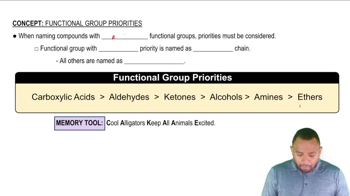
Functional Group Priorities Concept 1

Structural Representation

Structural representation refers to the way in which the arrangement of atoms in a molecule is depicted, often through structural formulas or diagrams. These representations provide insight into the connectivity and geometry of the compound, which is crucial for determining its name. Different types of structural representations include Lewis structures, condensed formulas, and skeletal formulas.
Recommended video:
Guided course
2:08
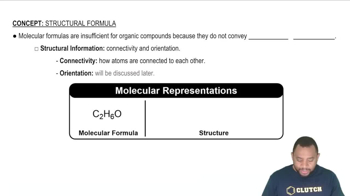
Molecular Representations Concept 1